
Swimming With Dolphins In Port Stephens: What Is Allowed
Most people searching for a swim with dolphins in Port Stephens end up on a dolphin watching boat, and that is roughly the right outcome: the trips you can book here are watching trips and net rides, with one separate operator running a wild dolphin swim under its own permit terms.
Short answer
The dolphin cruises bookable in Nelson Bay are watching trips and boom net rides, not dolphin swims. One operator, Dolphin Swim Australia, runs a wild dolphin swim, the operator's own price A$359 per person, ages 7 and over, 4.5 hours, October to the end of April. NSW approach rules set a 50 m vessel distance from dolphins.
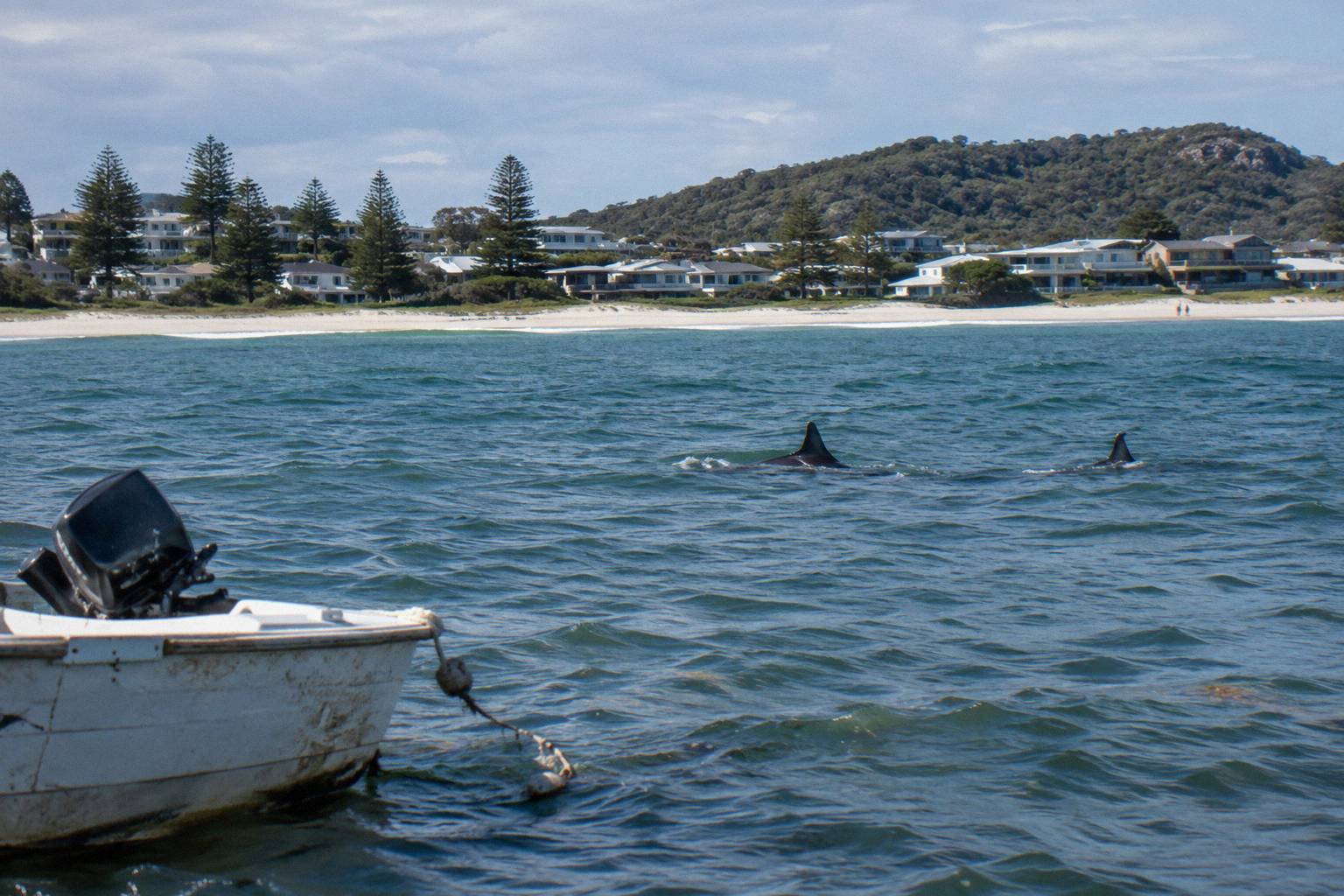
Roughly 90 to 120 Indo-Pacific bottlenose dolphins live permanently inside the Port Stephens-Great Lakes Marine Park, and the boats that go out to watch them leave from d'Albora Marina in Nelson Bay. What almost nobody tells you up front is that the water contact on those trips is a boom net ride and, on one cruise, a snorkel stop, and that a true swim beside wild dolphins is a different product run by a different operator with its own price, ages and seasons. This guide separates the two cleanly.
Can You Actually Swim With Dolphins In Port Stephens?
Most dolphin trips from Nelson Bay are watching cruises with an optional boom net ride, and none of them is a swim with dolphins, so if swimming beside wild dolphins is the goal, the only product is a separate operator's Wild Dolphin Swim at the operator's own price A$359 per person. The confusion starts with the word swim, which in Port Stephens gets attached to three different things: sitting in a net dragged through the water, snorkelling at an island stop, and holding a tow rope behind a sailing catamaran while wild dolphins swim nearby. Only the third is a dolphin swim, and it is run by Dolphin Swim Australia, which is not one of the cruise operators whose boats you can compare here. The distinction matters for families with young children, for anyone anxious about open water, and for price: watching trips start from A$46 per person while the wild swim sits at A$359.
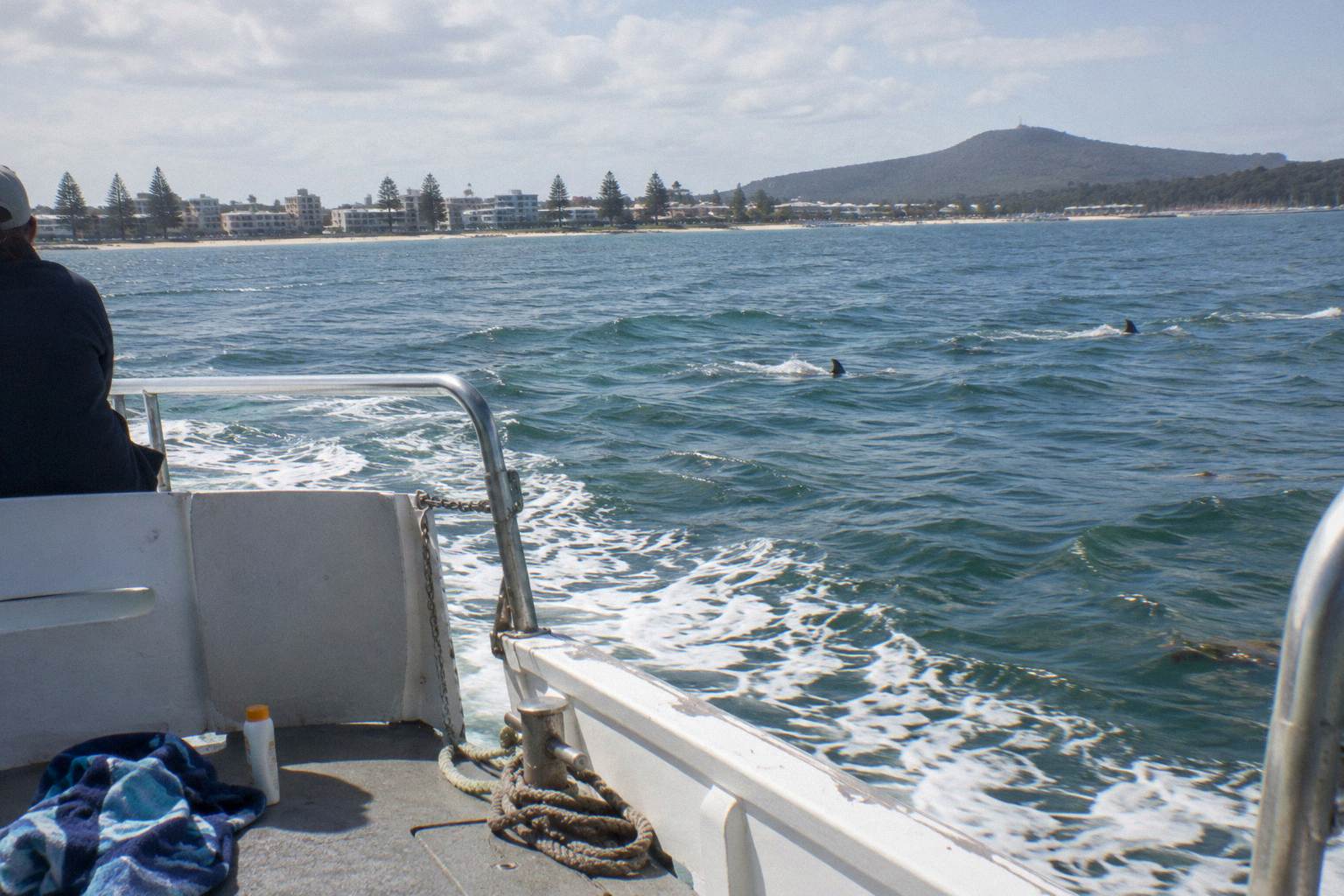
To understand why the trips are built this way, it helps to look at the rules the boats work under. NSW approach distances, set out by the NSW Government for whales, dolphins and dugongs, keep a vessel no closer than 50 m to a dolphin, with a caution zone starting at 150 m. Boats may not chase, corral or separate a pod, and when dolphins choose to bow-ride the vessel must hold course and speed rather than steering toward them. The rules are written for vessels: the published rules say nothing about touching and nothing about a swimming law, so any claim you see that swimming with dolphins is banned outright is going beyond what the published rules state.
That regulatory frame explains the shape of every product on the water. A cruise operator keeps the boat at a legal distance, cuts the engines or holds station, and lets the resident pod decide how close to come. Dolphins in the eastern section of the bay are often seen off Shoal Bay beach, and a second community lives at Broughton Island about 20 km away, so pods move through the marine park on their own schedule. The wild swim operator works within the same approach rules, using a tow rope or harness arrangement the operator describes on its own pages.
If the question behind your search is simply whether you will get wet on a dolphin cruise, the answer is that four of the boat trips include a boom net or nets, one includes a snorkel stop, and none of them promises a dolphin beside you in the water. The next sections set out exactly what each one offers, what the wild swim involves, and what the law actually says.
What The Dolphin Boats Actually Offer In The Water
Four cruises give you water contact of some kind: a boom net on the Dolphin Discovery, BBQ and Boom Net, Dolphin Watch Cruise and Sail and Marine Discovery trips, plus a bow net on two of them, and none of these is a swim with dolphins. A boom net is a net slung off the side of the vessel that guests sit in while the boat moves through the water. It is a ride, and the dolphins stay at their own distance from the boat. The trips differ in length, price and season, and the fastest way to see the spread is side by side, with every price in Australian dollars and shown as a from price.
| Trip | Operator | Duration | From price | Water contact |
|---|---|---|---|---|
| Dolphin Discovery Cruise | Moonshadow - TQC Cruises | 1.5 hours | from A$46 | Boom net |
| Dolphin Watch Cruise and Sail | Imagine Cruises | 1.5 hours | from A$50 | Dry bow-net and wet boom-net |
| 1-Hour Dolphin Watch Express | Aquamarine Adventures | 1 hour | from A$55 | None |
| BBQ and Boom Net Cruise | Moonshadow - TQC Cruises | 2 hours | from A$59 | Boom net |
| Marine Discovery Snorkel Cruise | Imagine Cruises | 3.5 hours | from A$100 | Snorkel stop, bow-net and boom-net |
| Wild Port Stephens Marine Park Cruise | Moonshadow - TQC Cruises | 1.5 hours | from A$46 | None |
Read that table with seasons in mind, because two of the water-contact trips do not run all year. The Dolphin Watch Cruise and Sail runs from November to the end of April, and the BBQ and Boom Net cruise runs December to April, so a winter visitor who wants a net ride has fewer options than a summer one. The Dolphin Discovery cruise runs all year, and its boom net stays inshore, which is worth knowing if the open sea concerns you. The deeper background on the net itself, including height rules for children, sits in the boom net experience explained guide.
The Dolphin Discovery cruise is the baseline most first-timers land on: 1.5 hours, from A$46 per person, captain's commentary, a bar on board and snacks to buy, swimsuit and towels for the net not included, rated 4.4 from 1,047 reviews. Moonshadow says the dolphins are totally wild, that 100% sighting success is not guaranteed, and that if dolphins are not located it gives a non-transferable free return voucher on a standby basis rather than a cash refund. That voucher structure is common across the operators and is worth understanding before you book anything.
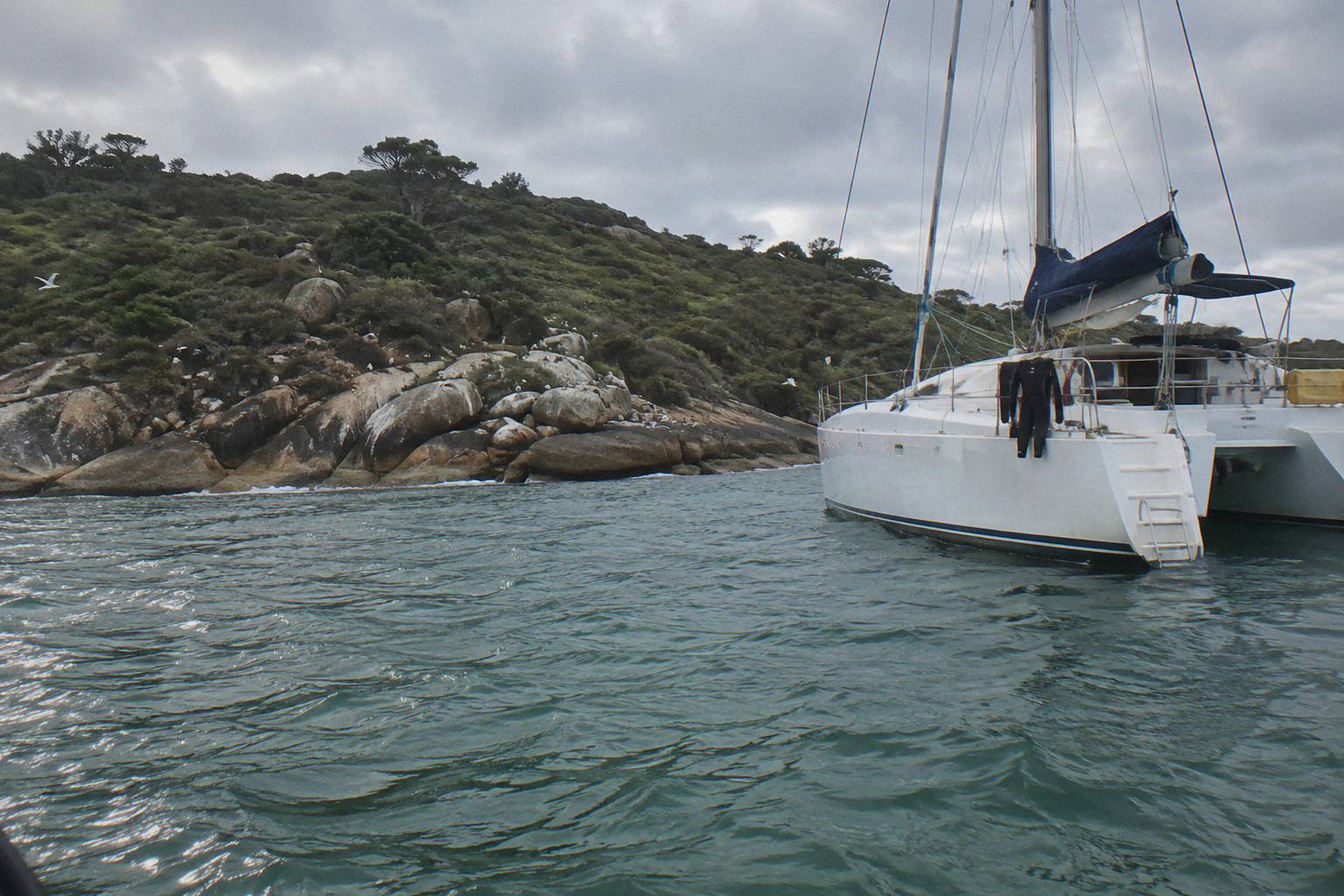
The sailing option deserves its own sentence or two. Imagine's Dolphin Watch Cruise and Sail runs on a sailing catamaran with 360-degree viewing, tea and coffee self-service included, a dry bow-net at the front and a wet boom-net at the back, and a Dolphin Guarantee in the form of a free return, carried on the operator's own terms. It runs November to April only, and it is flagged as unsuitable for wheelchair users, though the operator says it may help guests who can manage about five stairs. If sitting in a net while a catamaran heels through the bay sounds like the experience you imagined when you typed the word swim, from A$50 is the entry point.
The 1-Hour Dolphin Watch Express is the pure opposite bet: a fast power catamaran run out to the resident bottlenose dolphins, no nets, no snacks, the Aquamarine vessel Envision having no food or drink facilities at all, from A$55, rated 4.9 from 62 reviews. Some people want the shortest possible boat trip with the most time beside the pod; others want the full floating-afternoon. Only you know which camp you are in, but the price gap between the three is small enough that the choice should be about format, not cost.
For the wider picture across every boat in the bay, including the whale trips and the sailing comparison, the cruises compared guide breaks the whole fleet down by type, and the month-by-month season guide shows when each format is running.
The One Wild Dolphin Swim, And Who Runs It
Dolphin Swim Australia runs the Wild Dolphin Swim, the operator's own price A$359 per person, ages 7 and over, 4.5 hours from 6:15am to 11:00am, Friday, Saturday and Sunday plus extra school-holiday departures, October to the end of April. Swimmers hold a tow rope or harness behind a sailing catamaran, with up to 24 swimmers per trip, and a wetsuit, mask, snorkel and brunch are included per the operator. It is a separate product from every cruise compared on Port Stephens Dolphin Cruises, and it cannot be booked through any of the tour pages here: check dates and the current price with the operator directly.
The operator's own terms deserve a careful read before you commit A$359. The operator offers a free return within 12 months if you do not swim, and says plainly that there are no guarantees. The operator's species statements conflict between common and bottlenose dolphins, so no species is named for the swim. A 6:15am start also means a pre-dawn drive: Nelson Bay is about 2.5 hours by car from Sydney per the operator figure, and the practicalities of that drive are covered in getting to Nelson Bay for a dolphin boat.
| Wild Dolphin Swim detail | What the operator says |
|---|---|
| Price | Operator's own price A$359 per person |
| Minimum age | 7 and over |
| Duration | 4.5 hours, 6:15am to 11:00am |
| Departures | Friday, Saturday, Sunday, plus extra school-holiday departures |
| Season | October to the end of April |
| Format | Tow rope or harness behind a sailing catamaran, up to 24 swimmers |
| Included | Wetsuit, mask, snorkel, brunch, per the operator |
| If you do not swim | Free return within 12 months, operator terms |
Why the permit structure matters is worth a paragraph. The NSW approach rules govern vessels, and a swim operation works at the edge of that frame, which is why the operator leans on its permit claim rather than on any right of the swimmer. If you see marketing elsewhere promising you will swim with dolphins or naming a success rate as fact, treat both with caution: the only figures that exist here are the operator's own, labelled as such. For the reasons behind the strict approach distances, and the history people often half-remember, see why you cannot swim with dolphins anymore and why you cannot touch a dolphin.
The Snorkel Cruise: The Closest Bookable Thing To Getting In The Water
The Marine Discovery Snorkel Cruise, from A$100 per person for 3.5 hours with Imagine Cruises, is the only bookable trip here that puts you in the water with a mask on: a qualified dive-master guide leads the snorkelling, gear is included, and the operator says dolphins are sometimes seen en route. Guests must be able to swim to snorkel, and non-swimmers are welcome as observers, which makes it a workable family compromise when one half of the group wants to get wet and the other wants to stay dry. Tea, coffee and water are included; wetsuits and towels are not, so bring your own or hire one. Sailing happens when conditions permit, and the trip carries a bow-net and boom-net alongside the snorkel stop.
Set against the wild swim, the differences are stark and worth spelling out. The snorkel is a 3.5-hour mid-bay morning or afternoon at less than a third of the swim price, with dolphins as a possible sighting from the boat rather than the purpose of the immersion. The wild swim is a dawn mission built entirely around entering the water beside moving dolphins, with the operator's no-guarantees caveat attached. If your mental image of swimming with dolphins is floating in clear water while a curious pod circles you, neither product promises that image, and the snorkel at least delivers a guaranteed swim in the marine park, boating and snorkelling being allowed even in sanctuary zones.
The wildlife on the snorkel trip is broader than dolphins alone. The cruise travels through the Port Stephens-Great Lakes Marine Park, created in 2005, which has four zone types and two 4-knot speed areas at Middle Grounds and across the Jimmys Beach sanctuary zone, identified as important resting and feeding areas for the resident bottlenose dolphins. Watching the boat slow to a crawl in those zones is a small lesson in why the pod stays: the rules protect the feeding grounds, and the feeding grounds keep roughly 90 to 120 dolphins resident, per the NSW National Parks and Wildlife Service.
Cancellation terms are the same as across the trip range: free cancellation up to 24 hours before for a full refund. For what to pack, the what to wear on a dolphin boat guide covers layers for the cooler months, and if motion is a concern, a pharmacist can advise on motion-sickness options.
The Official Approach Rules And What They Actually Say
NSW approach distances, published by the NSW Government, keep a vessel no closer than 50 m to a dolphin and 100 m to a whale, with caution zones at 150 m and 300 m respectively, a 500 m rule for a mostly white animal, and a flat prohibition on entering a caution zone when a calf is present for closer viewing. The full set of distances is on the official approach distances page, and every cruise operator works inside it. Inside a caution zone a vessel approaches from the side at least 30 degrees at constant slow speed, keeps a lookout when two or more people are aboard, and only three vessels may be in the whole caution zone at once. If dolphins bow-ride, the vessel maintains course and speed.
| Situation | Official distance or rule |
|---|---|
| Vessel to dolphin | No closer than 50 m |
| Dolphin caution zone | Starts at 150 m |
| Vessel to whale | No closer than 100 m |
| Whale caution zone | Starts at 300 m |
| Calf present | No entering the caution zone for closer viewing |
| Mostly white animal | 500 m always |
| Vessels in a caution zone | Three at most, side approach 30 degrees, constant slow speed |
| Jet ski | 300 m |
| Drone | 100 m |
| Helicopter | 500 m |
Two practical consequences follow for a visitor. First, if you bring a drone to film your dolphin cruise, the 100 m drone rule applies, and the crew will tell you to keep it down. Second, the boats' behaviour around a pod is not idiosyncrasy but law, so when a skipper holds off at distance while a pod travels toward the boat, that patience is the rule working as designed. Moonshadow's own published practice of limiting time per pod and boat numbers near dolphins is the operator's wording about how it runs things, not the statute itself.
The rules as published say nothing about touching and nothing about swimming: they regulate vessels. Anyone telling you a specific law bans swimming with dolphins in NSW is filling a gap the published rules leave open.
Why The Distances Exist: What The Research Found
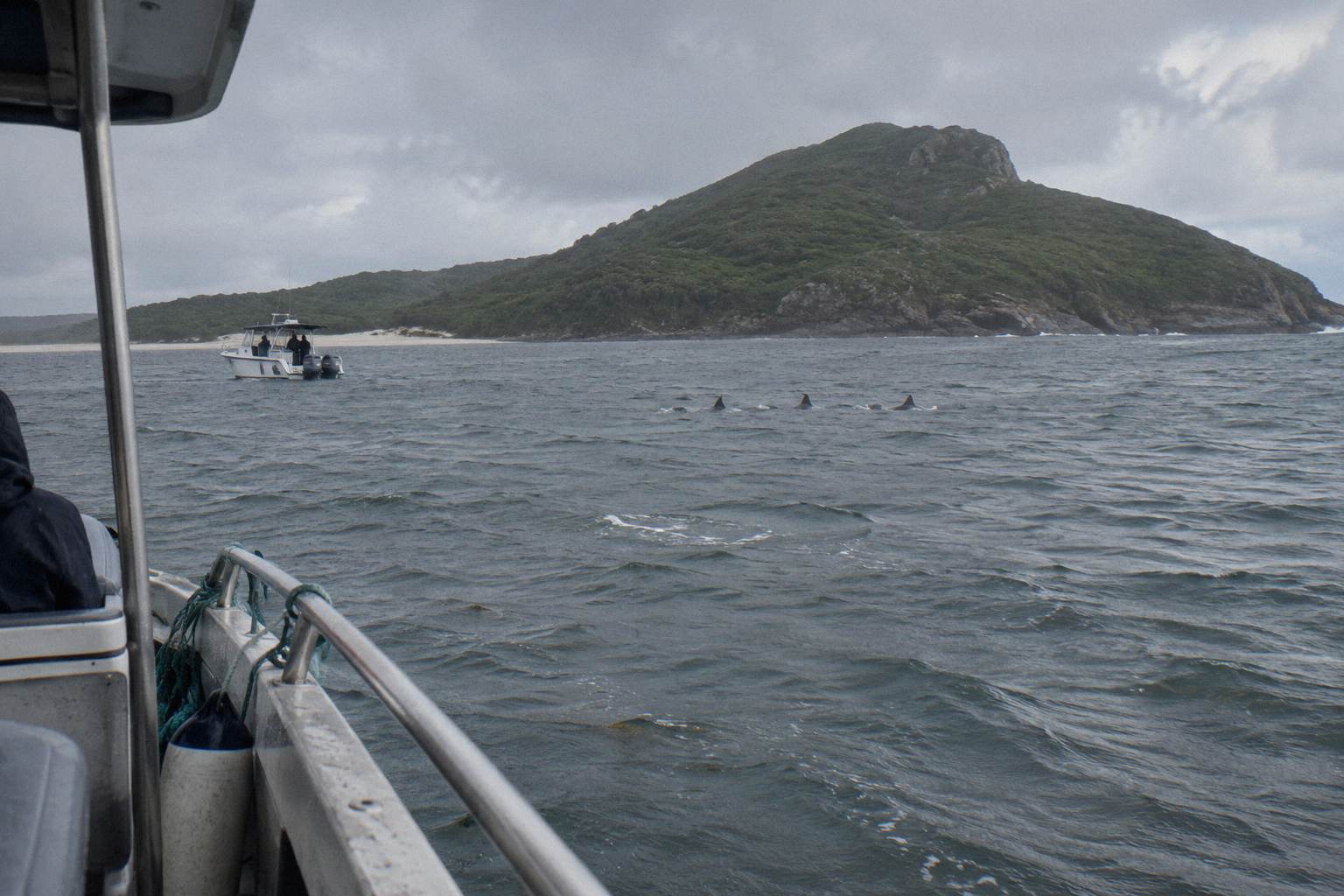
A 2012 Journal of Environmental Management paper by Steckenreuter, Moller and Harcourt, using boat surveys from August 2008 to August 2009, found that while dolphin-watching boats were present, dolphins fed and socialised less, and groups with newborns came closer than the minimum distances in nine of ten encounters. Those are 2008 to 2009 observations from before today's approach rules, so they are history, not a claim about present-day boats. The paper is published and readable, and it is the strongest evidence in the public record for why the caution zones, the three-vessel cap and the calf rule exist in their current form.
The connection to a swim product is direct. A wild swim works only if dolphins tolerate a vessel long enough for swimmers to enter the water beside it, which is exactly the scenario the research says changes dolphin behaviour, particularly for groups with newborns. Macquarie University research on the Port Stephens population adds a reason for local caution: the pod is genetically distinct and seldom interbreeds with coastal dolphins, so disturbance here affects a population that does not replenish from outside. Some travel beyond the Heads and a second community lives near Broughton Island, but the core group's isolation is what makes the marine park's 4-knot resting areas and the approach distances a coherent system rather than red tape.
For a visitor, none of this argues against going out. Roughly 90 to 120 resident dolphins, a 30 to 40 year lifespan, and an annual Community Dolphin Census run locally all point to a stable population sharing the bay with a well-regulated fleet. It argues for choosing operators that state their terms plainly, which is what the sighting and refund conditions in the tables above are for, and for treating any promise of contact as a red flag.
Mistakes To Avoid When Booking A Dolphin Trip
The five common mistakes are booking a boom net trip believing it is a dolphin swim, expecting the sailing cruise in winter, assuming a sighting guarantee means a refund, mixing up the two boarding points in Nelson Bay, and bringing a pram aboard when only collapsible strollers are stored. Each one is avoidable with a minute of checking, and each has a specific fix.
| Mistake | What goes wrong | The fix |
|---|---|---|
| Treating the boom net as a swim | It is a net ride, not a swim with dolphins | Book the wild swim with its operator if a true swim is the goal |
| Expecting the sail cruise in winter | It runs November to April only | Pick an all-year trip such as the Dolphin Discovery cruise |
| Reading guarantee as refund | Moonshadow gives a free return voucher on standby, not cash | Check each operator's sighting terms before booking |
| Wrong boarding point | Most boats leave d'Albora Marina; the BBQ cruise boards at Wharf 1, Victoria Parade | Read the dock on your booking confirmation |
| Bringing a pram | Prams are not allowed; collapsible strollers are stored by the crew | Bring a folding stroller or a carrier |
Boarding details matter more than visitors expect. The dolphin boats leave from d'Albora Marina on the Teramby Road side, and the dock for your trip is on your booking confirmation; the BBQ and Boom Net cruise alone boards at Wharf 1, Cruise Passenger Terminal, 40 Victoria Parade. Moonshadow asks guests to board about 15 minutes before departure, and its Stockton Street office is not the boarding point. Parking at d'Albora and Victoria Parade is paid up to 4 hours between 8:30am and 4:30pm, some nearby streets are free and unlimited, and the number plate is the ticket, so check the signs and the app.
Ages catch families out too. On the Moonshadow boom net, children under 1.1 m may not use the net unattended and smaller children go with an adult, per the operator. The wild swim requires ages 7 and over. Moonshadow's age bands run child 4 to 14 and infant 0 to 3, with child fares set by the operator and shown on the operator. For a fuller walk-through of family logistics, the dolphin boat trips with kids guide covers strollers, nets and the practical order of the day.
Which Trip To Pick If You Cannot Do The Wild Swim
Pick the Marine Discovery snorkel cruise from A$100 if being in the water matters most, the Dolphin Watch Cruise and Sail from A$50 if you want the net ride under sail, the Dolphin Discovery cruise from A$46 if you want the all-year default with the biggest review pool, or the 1-Hour Express from A$55 if you want the shortest trip. Every one of them carries free cancellation up to 24 hours before for a full refund, which removes most of the risk from choosing wrong, and all prices are per person in Australian dollars.
Season should narrow it faster than price. In the warmer months the whole range is open, including the November-to-April sailing cruise and the December-to-April BBQ trip with its sausage sizzle. In winter the sailing and BBQ options close, the snorkel's sailing is conditions-dependent, and the all-year boats carry the day. Dolphins themselves are not seasonal: the NPWS visitor guide for the resident pod is clear that the roughly 90 to 120 bottlenose dolphins live in Port Stephens permanently and can be seen at any time of year, a point expanded in the month-by-month dolphin season guide.
Your own comfort in the water is the last filter. The boom net on the Dolphin Discovery cruise stays inshore, the BBQ and Boom Net operator flags that trip as unsuitable for people prone to seasickness, and the longer trips simply spend more time out. No boat here is described as wheelchair accessible, and the Dolphin Discovery, sailing and snorkel operators all flag their vessels as unsuitable for wheelchair users, so raise mobility needs with the operator before booking. If a health condition or pregnancy is in play, speak to a doctor first, as the Sydney day trip's own terms do.
The Dolphin Discovery cruise remains the volume choice for a reason, with 4.4 from 1,047 reviews behind it, and the boom net, commentary and all-year schedule make it the easiest yes for a first visit. Check dates and the current price on the Dolphin Discovery cruise page, or compare it directly against the trio below.
For travellers without a car, the day trips fold a dolphin cruise into a bigger itinerary. The Sydney coach day trip, 12 hours from A$199, includes a 90-minute Dolphin Discovery eco cruise with an optional boom net swim, a koala sanctuary visit and Stockton Beach 4WD and sandboarding instruction, rated 4.6 from 354 reviews. The Newcastle day tours from A$240 and A$295 both include a dolphin cruise with Newcastle accommodation pickup, the Animal Lovers version adding Oakvale Wildlife Park and a BBQ lunch. None of these is a dolphin swim either, but each puts a net ride inside a full day out.
If the aim is whales rather than dolphins, the whale watching season runs May to November, with up to 40,000 humpbacks passing NSW, and the whale express from A$99, 4.5 from 87 reviews, carries a whale guarantee in the form of a free return voucher valid 12 months. Some guests report dolphin sightings on it too. The combined whale and dolphin cruise question is covered separately.
Whichever way you go, hold the distinction this guide turns on. A swim with dolphins in Port Stephens is one operator's A$359 dawn trip with its own terms, and everything bookable from the marina is a watching trip with a net or a snorkel attached. Both can be brilliant days on the water, and the roughly 90 to 120 resident bottlenose dolphins are there all year, but they are different products, priced differently, for different travellers.
Common Questions About Swimming With Dolphins In Port Stephens
Can You Swim With Dolphins In Port Stephens?
A true swim beside wild dolphins is run by one operator, Dolphin Swim Australia, at the operator's own price A$359 per person, ages 7 and over, October to the end of April. The dolphin cruises from Nelson Bay are watching trips with boom net rides, and one snorkel trip, none of which is a dolphin swim.
Is The Boom Net A Swim With Dolphins?
No. A boom net is a net slung off the vessel that guests sit in while the boat moves. It is a net ride, and the dolphins keep their own distance from the boat under the NSW approach rules, which hold vessels 50 m from a dolphin.
Is Swimming With Dolphins Banned In NSW?
The published NSW approach rules govern vessels, setting distances for boats, jet skis, drones and helicopters. They say nothing about swimming, so any claim that swimming with dolphins is banned outright goes beyond the published rules; the wild swim is a separate operator product.
How Close Do The Boats Get To The Dolphins?
A vessel may move no closer than 50 m to a dolphin, with a caution zone starting at 150 m, a side approach of at least 30 degrees at constant slow speed, three vessels maximum in the caution zone, and no closer viewing at all when a calf is present.
What Is The Cheapest Trip With Water Contact?
The Dolphin Discovery cruise from A$46 per person includes the boom net experience on a 1.5-hour trip that runs all year. The Dolphin Watch Cruise and Sail from A$50 adds a dry bow-net and a wet boom-net under sail from November to April, and the snorkel cruise is from A$100.
Do Any Dolphin Cruises Guarantee Sightings?
No cruise guarantees dolphins. Moonshadow says 100% sighting success is not guaranteed and gives a non-transferable free return voucher on standby if dolphins are not located; Imagine carries a Dolphin Guarantee in the form of a free return. Neither is a cash refund.