Dolphin Watching In Port Stephens: Which Boat Gets You Closest
Every dolphin boat in Port Stephens works under the same NSW approach distances, so the real choice is boat type, duration and format, not proximity. Here is how the sailing catamaran, the boom net boats, the fast express and the marine park eco cruise actually differ.
Short answer
No dolphin boat in Port Stephens may move closer than 50 m to a dolphin under NSW law, so no vessel gets you nearer by design. The choice comes down to format: a sailing catamaran from A$50, a boom net cruise from A$46, a fast 1-hour express from A$55 or a 3.5-hour snorkel sail from A$100, all in Australian dollars.
Roughly 90 to 120 Indo-Pacific bottlenose dolphins live permanently in the waters of Port Stephens inside the marine park, according to the NSW National Parks and Wildlife Service. That resident pod is the reason Nelson Bay runs dolphin trips in every month of the year. It is also the reason the question "which boat gets you closest" has an answer most visitors do not expect: the law decides the distance, and the boats decide everything else.
Under the NSW Government's approach distances, a vessel may move no closer than 50 m to a dolphin, and 100 m to a whale, no matter which jetty it left from. A sailing catamaran, a 26 m twin-deck boat and a fast power catamaran all stop at the same line. What separates the trips is the ride itself: under sail or under motor, one hour or three and a half, dry viewing deck or a net slung into the water.
How Close Can A Dolphin Boat Actually Get?
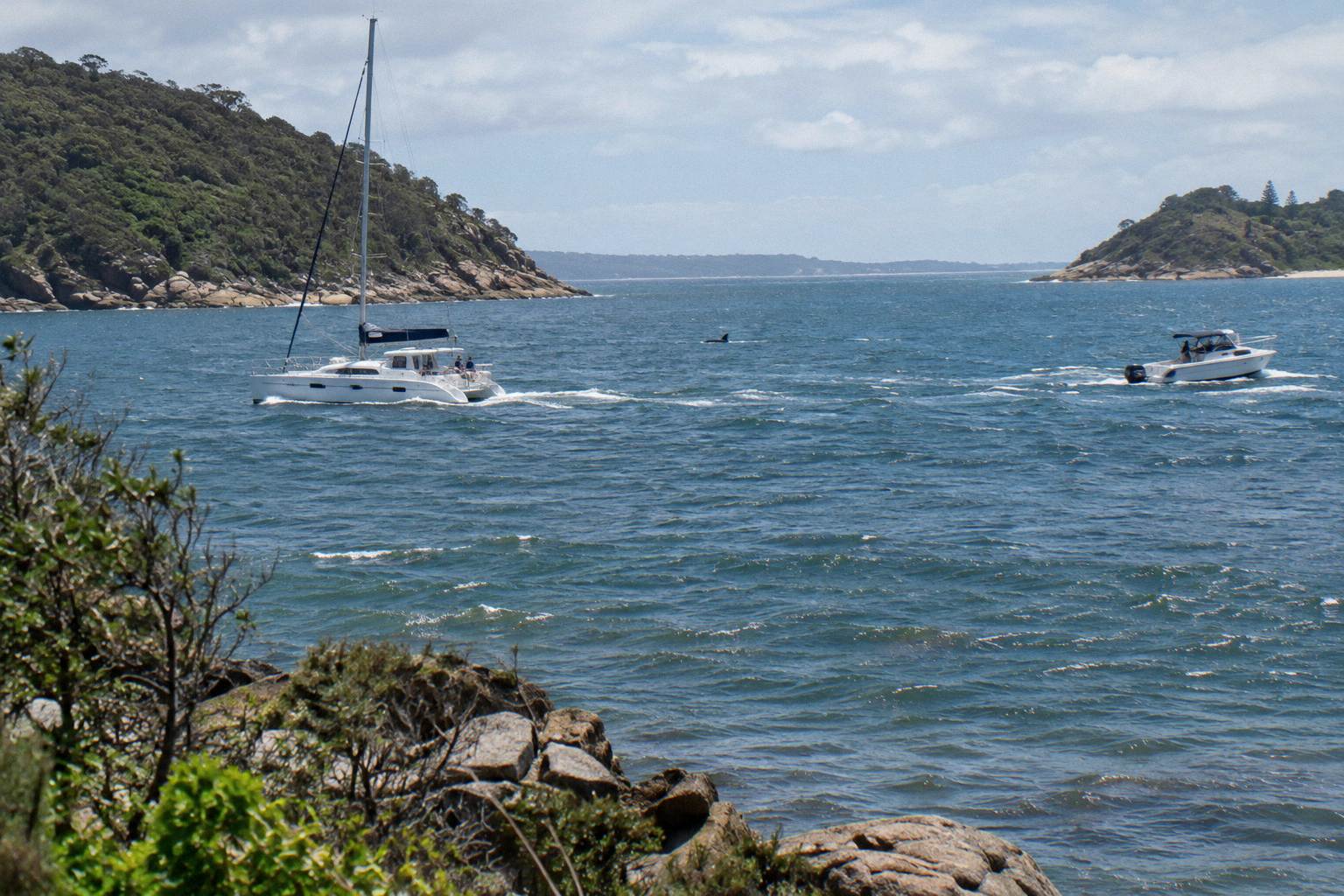
Under NSW law every vessel stops at least 50 m from a dolphin, and the choice of boat changes nothing about that distance. The caution zone for dolphins begins at 150 m; inside it a boat must approach from the side at least 30 degrees, at constant slow speed, with a lookout posted, and only three vessels may sit in the whole caution zone at once. A calf in the group closes the zone completely for closer viewing.
Those figures come from the NSW Government's approach distances for whales, dolphins and dugongs, published at environment.nsw.gov.au. They are rules for vessels, not for people: they say nothing about touching or swimming, so no boat can sell you a closer look as a feature. One line in the rules matters more than any marketing copy: if dolphins choose to bow-ride, the vessel must maintain course and speed. In other words, the only lawful way a dolphin comes close to a boat is when the dolphin decides to.
| Situation | Minimum distance | What the boat must do |
|---|---|---|
| Dolphin, open water | 50 m | No closer; caution zone from 150 m |
| Whale | 100 m | Caution zone from 300 m |
| Dolphin or whale calf present | No entry to caution zone | No closer viewing at all |
| Mostly white animal | 500 m | Always, any species |
| Inside the dolphin caution zone | 150 m to 50 m | Approach from the side at least 30 degrees, constant slow speed, lookout posted, three vessels maximum |
| Jet ski | 300 m | Stays outside |
| Drone | 100 m | Stays outside |
Moonshadow's own practice of limiting time per pod is the operator's wording, not law; the binding numbers are the NSW Government's above. Some visitors weigh this against swimming with dolphins in Port Stephens and what is allowed, a different activity with its own rules. The practical takeaway for a boat choice is simple: pick the ride you want, because the distance is fixed for everyone.
Who Are The Port Stephens Dolphins?
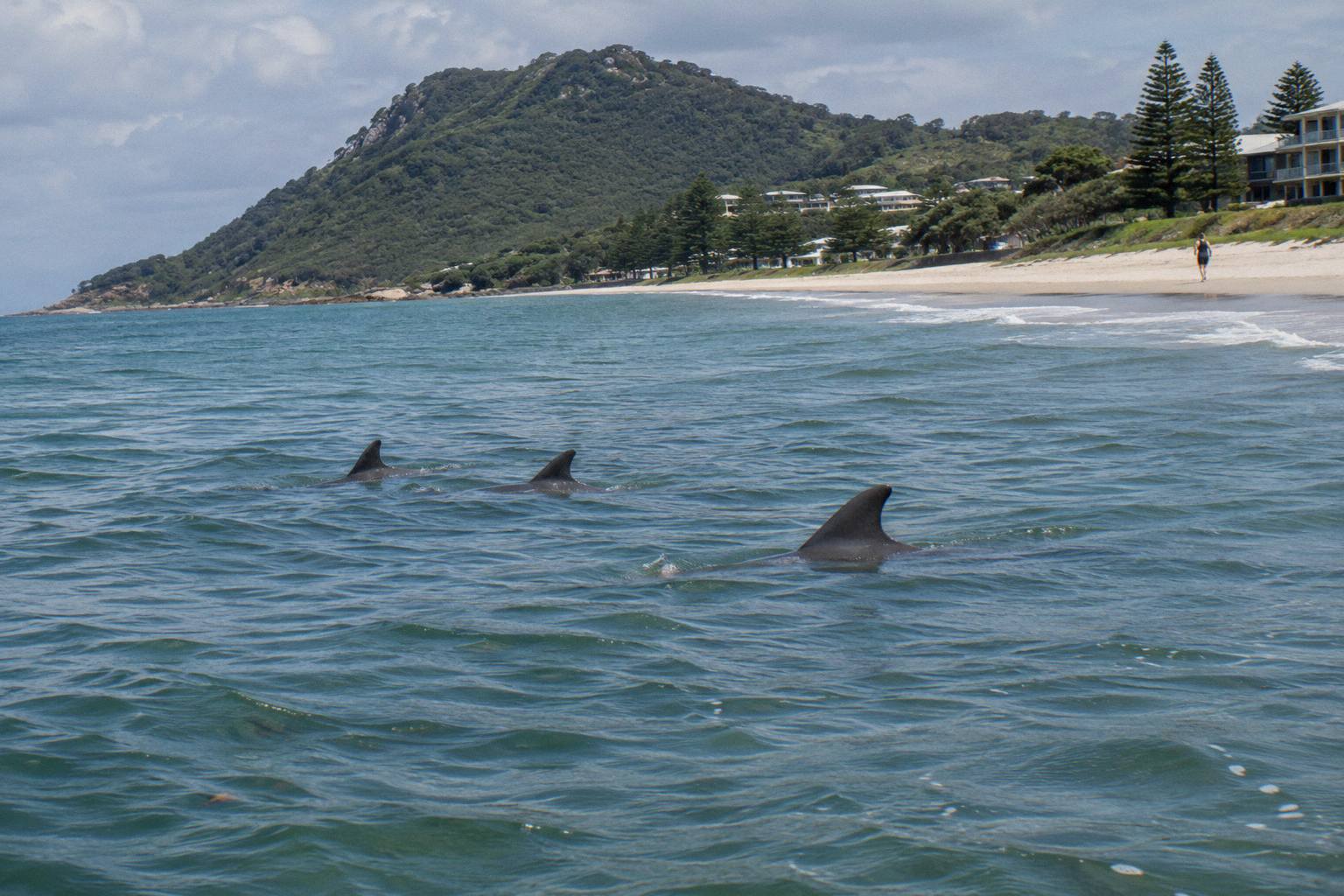
The pod is a resident population of roughly 90 to 120 Indo-Pacific bottlenose dolphins (NPWS), living year-round inside the Port Stephens-Great Lakes Marine Park. Macquarie University research found the population is genetically distinct and seldom interbreeds with coastal dolphins. A second community lives near Broughton Island about 20 km away, and some Port Stephens animals travel outside the Heads.
That residency is why dolphin watching here works in every season, a point covered in depth in dolphin watching season in Port Stephens, month by month. The dolphins can live 30 to 40 years, they are often seen off Shoal Bay beach in the eastern section of the port, and an annual Community Dolphin Census tracks them. Because they are permanent residents, no trip needs to chase them out to sea; the boats work the bay and the headlands where the pod actually feeds and rests.
The marine park itself shapes the trips. Created in 2005, the Port Stephens-Great Lakes Marine Park runs four zone types: sanctuary, habitat protection, general use and special purpose. Boating, snorkelling and diving are allowed in sanctuary zones, and collecting is not. Two areas, Middle Grounds and all of the Jimmys Beach sanctuary zone, carry 4-knot speed limits because they are important resting and feeding areas for the resident bottlenose dolphins. An eco cruise that interprets the park, and a snorkel sail that stops in it, engage with that framework in a way a quick harbour loop does not.
Sailing Catamaran, Boom Net Boat, Express Or Eco Cruise?
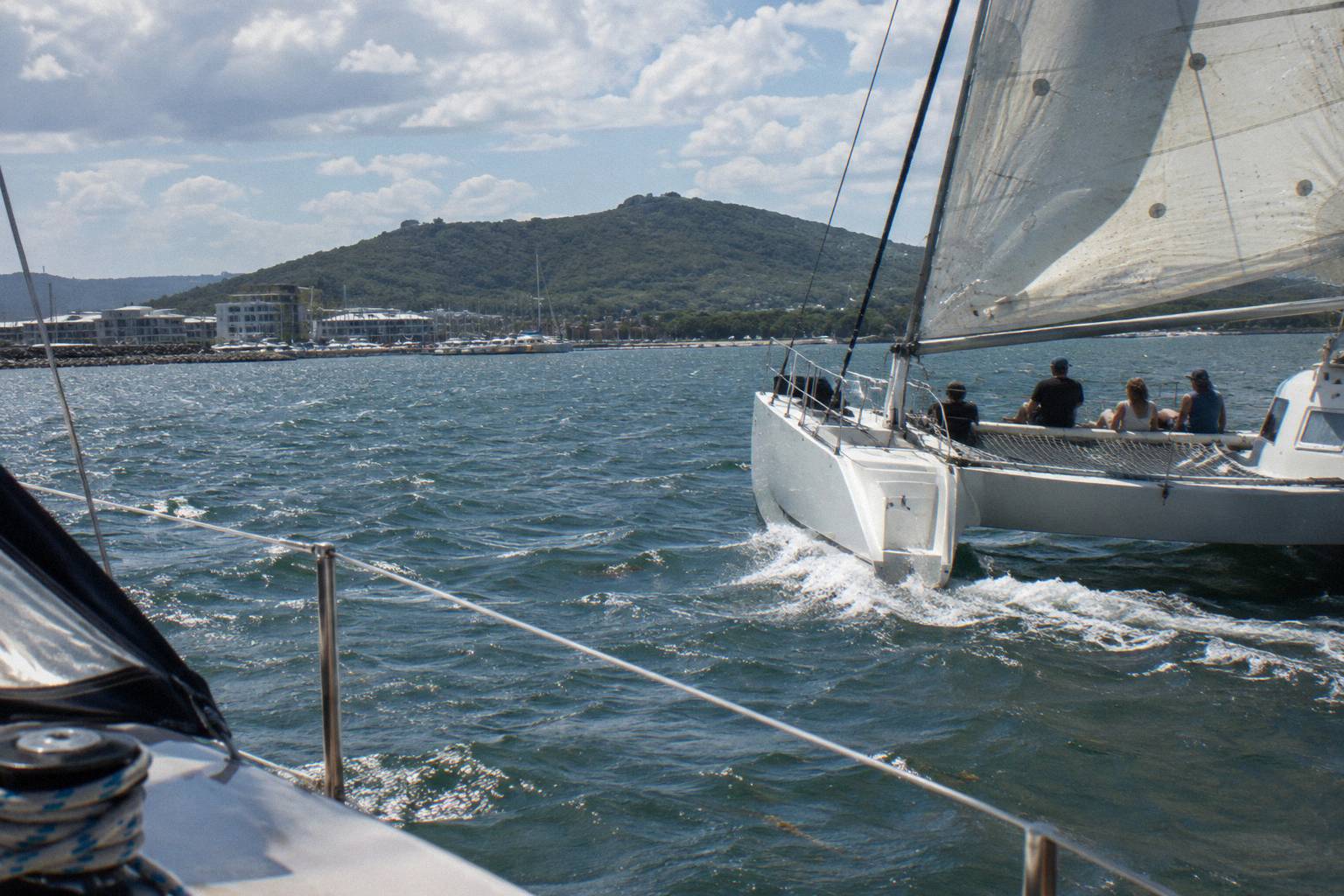
The four formats split cleanly: the Imagine sailing catamaran (from A$50, 1.5 hours, November to April) runs quietest and carries a dolphin free-return guarantee; the Moonshadow boom net boats (from A$46 and A$59) add a net ride and commentary; the Aquamarine express (from A$55) is a fast 1-hour run; and the Wild Port Stephens eco cruise (from A$46) tours the marine park with no boom net at all. All prices are per person, in Australian dollars, and change, so check the current price when you look at dates.
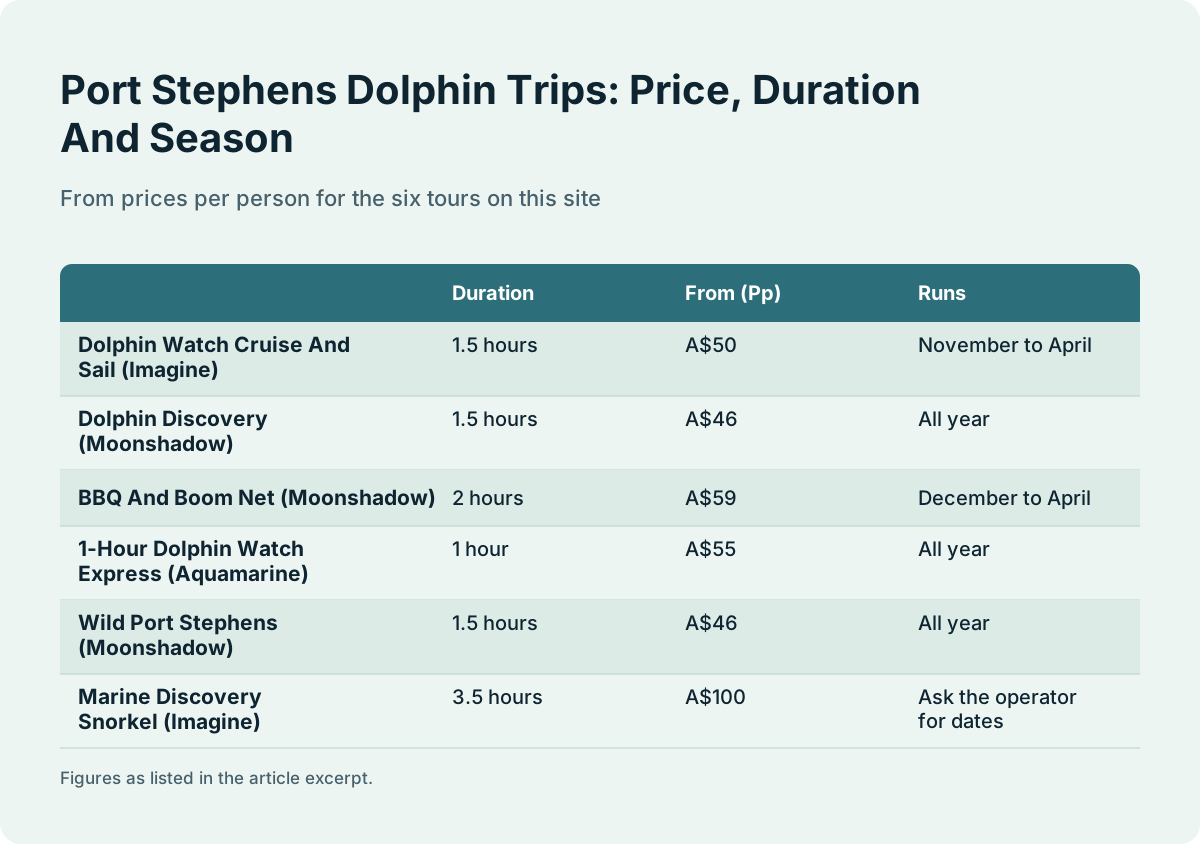
| Trip | Boat type | Duration | From (per person) | Boom net | Runs |
|---|---|---|---|---|---|
| Dolphin Watch Cruise and Sail (Imagine) | Sailing catamaran | 1.5 hours | A$50 | Dry bow-net and wet boom-net | November to April |
| Dolphin Discovery (Moonshadow) | Twin-deck vessel | 1.5 hours | A$46 | Yes, stays inshore | All year |
| BBQ and Boom Net (Moonshadow) | Twin-level boat, walk-around decks | 2 hours | A$59 | Yes | December to April |
| 1-Hour Dolphin Watch Express (Aquamarine) | Power catamaran | 1 hour | A$55 | No | All year |
| Wild Port Stephens (Moonshadow) | MV Osprey, 24 m, panoramic decks | 1.5 hours | A$46 | No | All year |
| Marine Discovery snorkel (Imagine) | Sailing catamaran | 3.5 hours | A$100 | Bow-net and boom-net | Ask the operator for dates |
The catamaran argument is about engine noise and viewing angles: 360-degree viewing, a dry bow-net at the front and a wet boom-net at the back, tea and coffee included, and a sailing motion when the wind allows. The boom net argument is about the ride itself, a net slung off the vessel you sit in while the boat moves; the boom net dolphin experience in Nelson Bay explained covers what that actually involves. The express argument is time: one hour on the water with the resident pod and back at the marina. The eco cruise argument is the park: commentary, panoramic decks and wildlife watching across the marine park on the MV Osprey, which has no boom net.
Timing matters more than price here. If you are visiting between May and October, the sailing catamaran and the BBQ and Boom Net trip are off the table, since they run November to April and December to April respectively; only the Dolphin Discovery, the express and the Wild Port Stephens eco cruise run all year. In peak summer, all six options compete, including the 3.5-hour Marine Discovery snorkel sail at from A$100, which needs its dates confirmed directly with the operator.
On budget, the spread is narrower than it first looks: the two cheapest options, Dolphin Discovery and Wild Port Stephens, both start at A$46, so the real choice between them is whether you want a boom net ride or a no-boom-net marine park tour on a 24 m boat with panoramic decks. Paying A$55 for the express buys you a shorter trip, not a cheaper one, while the A$59 BBQ and Boom Net option adds an extra half hour over the standard 1.5-hour format. Only the snorkel sail, at from A$100 and 3.5 hours, sits in a different price band altogether.
If you want a fuller side-by-side that includes the whale and sunset boats, see Port Stephens cruises compared: dolphin, whale, sailing and sunset. For a first visit, the hinge is duration and boat feel, not the dolphins: the pod is the same pod whichever deck you stand on.
Does The Boom Net Put You Nearer The Dolphins?
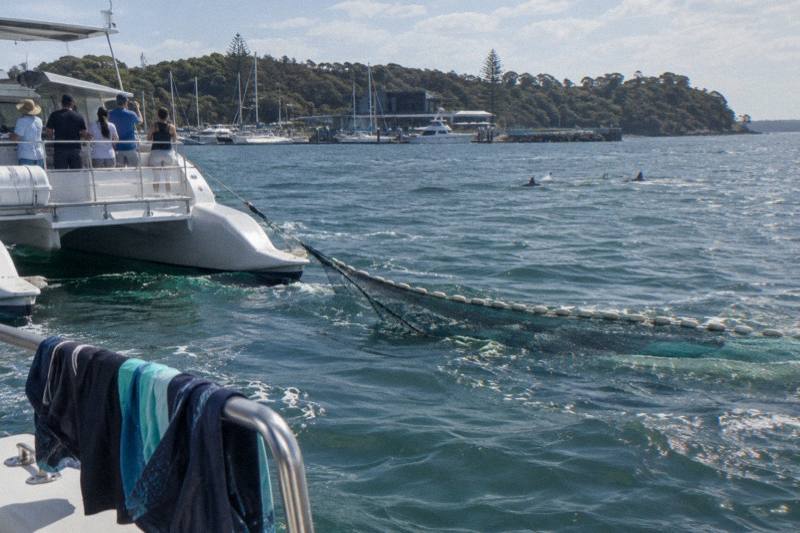
No. A boom net is a net slung off the side of a boat that guests sit in while the vessel moves; it is a ride, never a swim with dolphins, and the 50 m approach rule applies to the whole boat, net included. The net sits in the water on the trips that have one, but no operator promises a dolphin near it, and the dolphins are wild animals that come and go on their own.
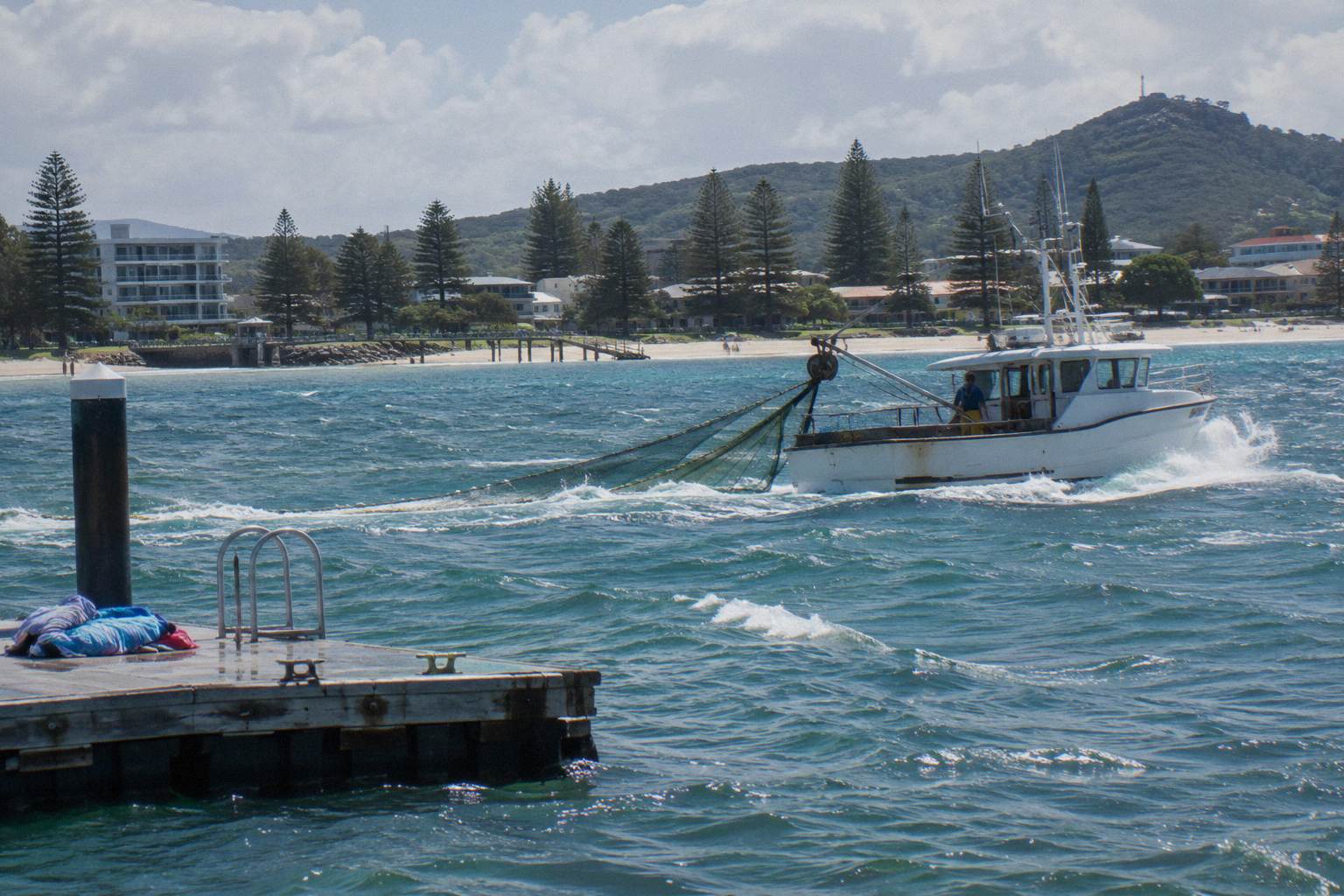
Four trips carry a net: the Dolphin Discovery cruise, the BBQ and Boom Net cruise, the Dolphin Watch Cruise and Sail and the Marine Discovery snorkel, plus the option on two day trips. On the Moonshadow Dolphin Discovery cruise the boom net stays inshore, so the net ride happens inside the bay rather than beyond the headlands. You need your own swimsuit and towels; they are not provided. On the net, children under 1.1 m may not use it unattended and smaller children go in with an adult. It is worth being clear about what the net is for: fun and water, not proximity. A pod that chooses to bow-ride will pass the boat on its own terms, and the rules then require the skipper to hold course and speed exactly as they were.
The Dolphin Discovery cruise runs 1.5 hours from A$46 with captain's commentary, a bar on board and snacks to buy, 4.4 from 1,047 reviews. Moonshadow runs late morning and early afternoon departures all year, every day except Christmas Day, and asks guests to board about 15 minutes before departure.
Fast Or Slow: The 1-Hour Express Against The Longer Cruises?
The 1-Hour Dolphin Watch Express is the shortest and fastest trip: a power catamaran run to see the resident bottlenose dolphins, from A$55, 4.9 from 62 reviews. The 1.5-hour cruises add commentary, nets and food; the 2-hour BBQ cruise adds a sausage sizzle; and the 3.5-hour Marine Discovery sail adds snorkelling with gear included. Duration buys format, not distance.
The express suits a tight itinerary, a restless toddler or a morning when you simply want to be back on land by lunch. The trade-off is spartan: the Aquamarine power catamaran Envision has no snack or drink facilities, so bring what you need. There is no boom net on it. Non-folding strollers are not allowed, per its operator. What the express does deliver is speed to wherever the pod is working that day, which is a genuine plus when the dolphins are scattered across the eastern harbour.
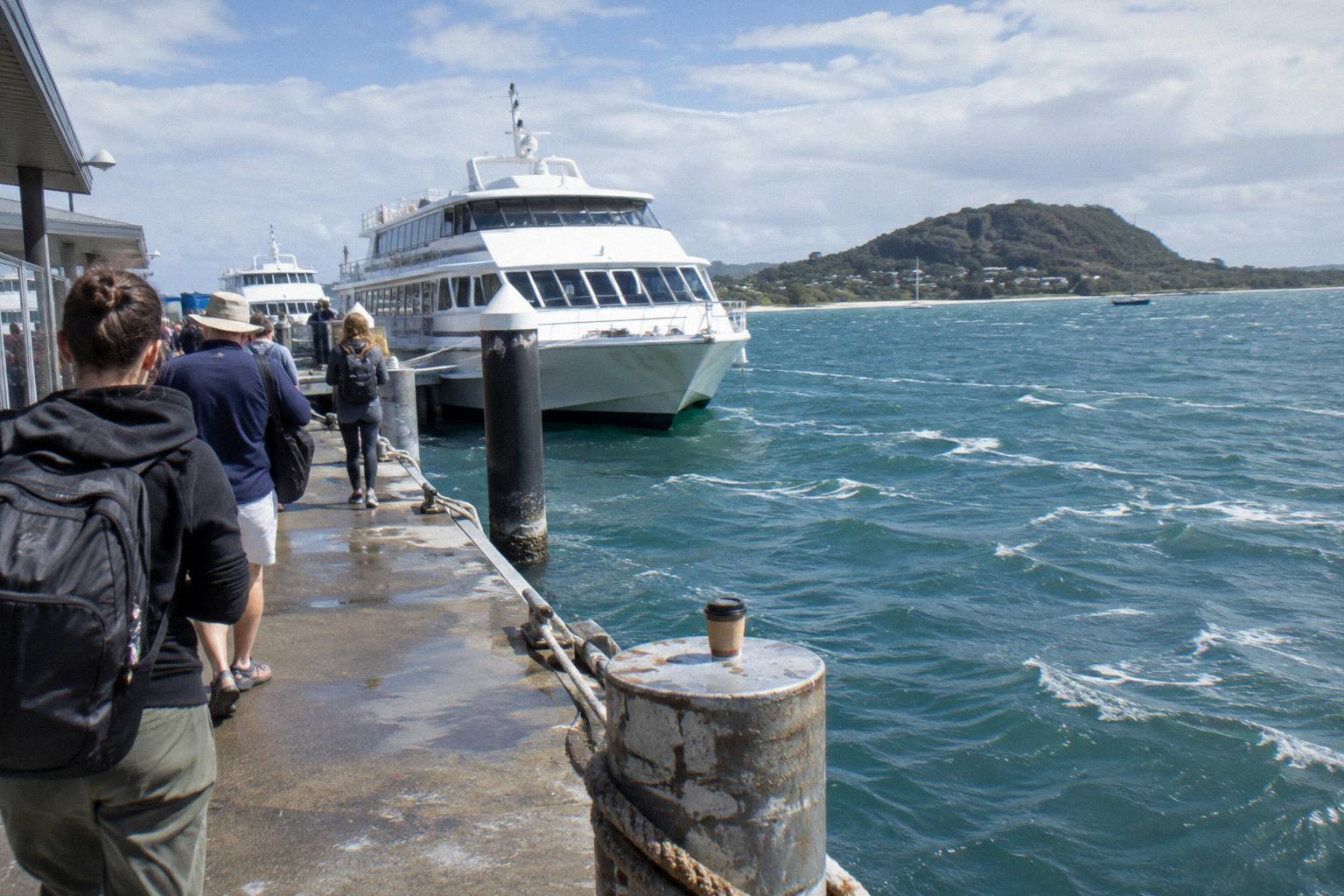
The longer end of the scale is the Marine Discovery snorkel cruise, 3.5 hours from A$100, sailing when conditions permit, with a qualified dive-master guide and snorkel, fins and mask included. Guests must be able to swim to snorkel; non-swimmers are welcome as observers. Wetsuits and towels are not included, so bring your own or hire one. Dolphins appear en route per the operator. Between those poles sit the 1.5-hour workhorses and the 2-hour BBQ and Boom Net cruise, December to April, whose operator flags it as not suitable for people prone to seasickness. For timing questions around the day itself, morning or afternoon for a Nelson Bay dolphin boat works through the practical differences.
When Does Each Boat Run?
Moonshadow's dolphin cruises run all year, every day except Christmas Day, with late morning and early afternoon departures and an extra afternoon departure in school holidays except winter. Imagine's sailing catamaran cruise runs November to the end of April only; the BBQ and Boom Net cruise runs December to April. Dolphins are present in every month, so winter simply removes the sailing options, not the dolphins.
That seasonal split matters more than most visitors realise. Arrive in July and the sailing catamaran, the bow-net-and-boom-net combo and the sausage sizzle are off the table; the twin-deck dolphin boats and the express are running. Arrive in January and everything runs, which is why the boom net cruises feel busiest in the holidays.
| Month | Dolphins | Sailing catamaran cruise | BBQ and Boom Net | Twin-deck dolphin cruises | Express |
|---|---|---|---|---|---|
| January | Resident pod, all month | Yes | Yes | Yes | Yes |
| April | Resident pod, all month | Yes, to end of April | Yes | Yes | Yes |
| July | Resident pod, all month | No | No | Yes | Yes |
| October | Resident pod, all month | No, restarts November | No, restarts December | Yes | Yes |
| December | Resident pod, all month | Yes | Yes | Yes | Yes |
Whale season, May to November, overlaps the quieter dolphin months, and up to 40,000 humpbacks pass the coast; whale watching in Port Stephens: boats and what you will see covers that side. Some guests report dolphin sightings on the whale express too, though its operator frames it as a lookout for dolphin pods rather than a promise.
What Do The Sighting Guarantees Actually Promise?
Each operator words it differently and none promises dolphins. Moonshadow says the dolphins are totally wild and that 100 percent sighting success is not guaranteed; if no dolphins are found it gives a non-transferable free return voucher on a standby basis, not cash. Imagine's sailing cruise carries a Dolphin Guarantee (Free Return). No trip here guarantees you will see dolphins, and no wording should be read as one.
The return-voucher mechanic is worth understanding before you book, because it changes what a "guarantee" is worth. A voucher means a free standby seat on a future cruise, which is generous if you live nearby or are staying a week, and useless if you fly out the next morning. Cancellation works the same across the trips: free cancellation up to 24 hours before for a full refund. Inside 24 hours, Moonshadow's own terms charge a standard cruise in full, amendments cost an admin fee, and missing the departure brings no refund or transfer; if the operator cancels, you get a full refund or a transfer. Weather and cancellation details are unpacked in weather and cancellations on Port Stephens dolphin boats.
One operational note for the eco cruise: if offshore conditions are poor, the Wild Port Stephens route may stay in the bay, per its operator. That is a route change, not a cancellation, and the bay is where the resident pod spends much of its time anyway.
What Do The Trips Cost And What Is Included?
Bay cruises cost A$46 to A$100 per person, while full day trips out of Sydney and Newcastle run A$199 to A$295, all from-prices set by each operator and subject to change. Inclusions differ sharply: tea and coffee on the sailing cruise, a sausage sizzle on the BBQ cruise, nothing available to buy on the express, and snorkel gear but no wetsuit on the Marine Discovery sail.
| Trip | Duration | From | Included | Buy or bring yourself |
|---|---|---|---|---|
| Dolphin Discovery (Moonshadow) | 1.5 hours | A$46 | Boom net experience, captain, commentary | Swimsuit and towels for the net; snacks and drinks |
| Dolphin Watch Cruise and Sail (Imagine) | 1.5 hours | A$50 | Tea and coffee, dry bow-net, wet boom-net | Own food and non-alcoholic drinks welcome; no BYO alcohol |
| 1-Hour Express (Aquamarine) | 1 hour | A$55 | The cruise | Anything to eat or drink |
| BBQ and Boom Net (Moonshadow) | 2 hours | A$59 | Sausage sizzle, boom net, commentary | Drinks |
| Wild Port Stephens (Moonshadow) | 1.5 hours | A$46 | Commentary, panoramic decks, wildlife watching | Snacks and drinks |
| Marine Discovery snorkel (Imagine) | 3.5 hours | A$100 | Dive-master guide, snorkel, fins, mask, tea, coffee, water | Wetsuit or hire one, towel |
Ticket pricing by boat type has its own breakdown at dolphin boat ticket prices by boat type in Nelson Bay; child and family fares are set by each operator and shown when you check dates. The vessels themselves differ in scale: the Moonshadow V is 26 m and the MV Osprey is 24 m with no boom net, per Moonshadow's own vessel page. The eco cruise is the quiet all-rounder of the fleet for wildlife watchers who do not want a net ride.
For the full field guide to the animals, see the bottlenose dolphins of Port Stephens and the resident pod. If the deeper question is whether the outing justifies its price at all, is a dolphin cruise worth it works through the arithmetic.
Common Mistakes When Choosing A Dolphin Boat
The recurring mistakes are booking the sailing catamaran for a winter visit, expecting the boom net to mean dolphins beside you, reading a return voucher as a refund, arriving at the wrong marina for the BBQ cruise, and comparing boats on proximity when the law fixes the distance for all of them. Each mistake is avoidable with one fact.
The winter mistake is the most common: the Dolphin Watch Cruise and Sail runs November to the end of April, full stop, and the BBQ and Boom Net cruise December to April. If your dates fall outside those windows, the twin-deck dolphin cruises and the express are the boats that run. The boom net mistake is about expectations: the net is a ride in moving water, and whether a pod appears near the boat is up to the dolphins, not the crew. The voucher mistake is about money: a free return on standby is not cash back.
The marina mistake is geographic: the dolphin boats leave from d'Albora Marina, Nelson Bay, with the dock on your booking confirmation, but the BBQ and Boom Net cruise boards at Wharf 1, Cruise Passenger Terminal, 40 Victoria Parade, a different place entirely. Parking at d'Albora and Victoria Parade is paid up to 4 hours between 8:30am and 4:30pm; some nearby streets, Laman, Church and Magnus, are free and unlimited. Where the boats leave from is covered in full at d'Albora Marina, where the Nelson Bay dolphin boats leave. And the proximity mistake is the one every buyer link in this decision should kill: no boat gets closer by design, so spend the comparison effort on format, duration and season instead. Planning with children adds its own layer at dolphin boat trips with kids in Port Stephens, and the practical packing angle is at what to wear on a Nelson Bay dolphin boat. The site behind Port Stephens Dolphin Cruises keeps the whole fleet comparison current as prices and seasons move.
Common Questions About Dolphin Boats In Port Stephens
Which Dolphin Boat Gets Closest To The Dolphins?
None gets closer than another. NSW law stops every vessel at least 50 m from a dolphin, with the caution zone starting at 150 m, so the real differences between boats are type, duration and format. If dolphins choose to bow-ride, the rules require the boat to maintain course and speed.
What Is The Cheapest Dolphin Cruise In Port Stephens?
The Dolphin Discovery cruise and the Wild Port Stephens eco cruise both start from A$46 per person, the lowest from-prices among the bay cruises. The 1-Hour Express starts from A$55 and the sailing catamaran from A$50. Prices change, so check the current price when you look at dates.
Is There A Dolphin Guarantee?
No cruise guarantees dolphins. Moonshadow says the dolphins are totally wild and 100 percent sighting success is not guaranteed, and gives a non-transferable free return voucher on standby if none are found. Imagine's sailing cruise carries a Dolphin Guarantee (Free Return) on its operator.
Can You Swim With The Dolphins On A Cruise?
No. The boom net is a net ride beside a moving boat, not a swim, and the approach rules govern vessels, not swimmers. No cruise here is a dolphin swim; a wild dolphin swim is run by a separate operator, on its own terms.
Do Dolphin Cruises Run In Winter?
Yes. The resident pod of roughly 90 to 120 dolphins stays all year, and Moonshadow's dolphin cruises run every day except Christmas Day with late morning and early afternoon departures. The sailing catamaran cruise runs November to April only, and the BBQ and Boom Net cruise December to April.
How Long Is A Dolphin Cruise In Port Stephens?
The express runs 1 hour; the Dolphin Discovery, sailing and eco cruises run 1.5 hours; the BBQ and Boom Net cruise runs 2 hours; and the Marine Discovery snorkel sail runs 3.5 hours. The Sydney coach day trip runs 12 hours and includes a 90-minute dolphin cruise.