
Why Can't You Swim With Dolphins Anymore?
The rules that shape dolphin swims in NSW, the one wild swim operator in Nelson Bay, and what the Nelson Bay boats offer instead of getting in the water with wild dolphins.
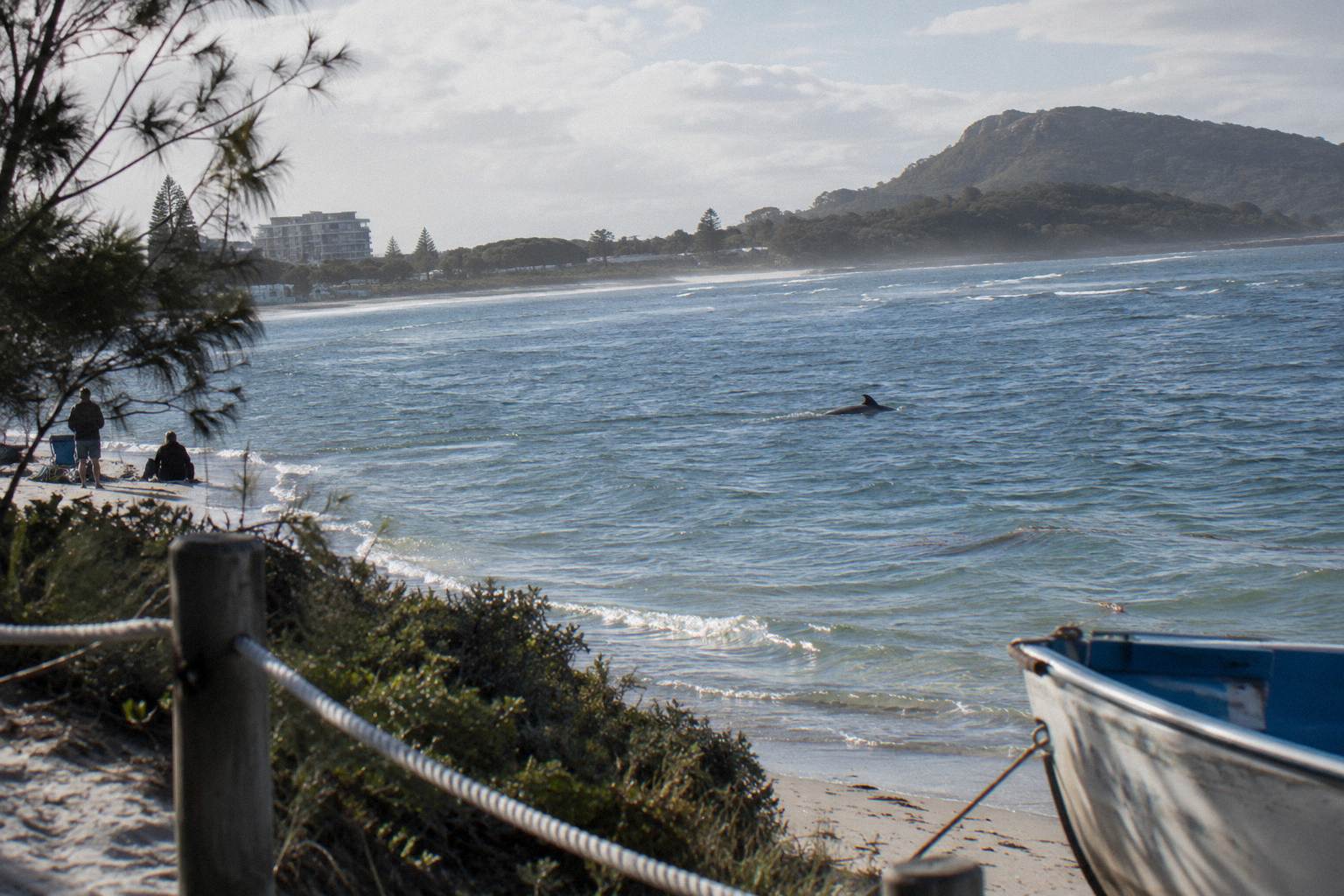
No NSW law bans swimming with dolphins outright, so the "anymore" in the question has no specific law or date behind it. What exists is different and more interesting: NSW law sets approach distances for vessels around dolphins, one specialist operator runs a wild dolphin swim, and every dolphin cruise leaving Nelson Bay is a watch-from-the-deck trip. Roughly 90 to 120 Indo-Pacific bottlenose dolphins live permanently in Port Stephens, and the boats built around them do not put passengers in the water beside them.
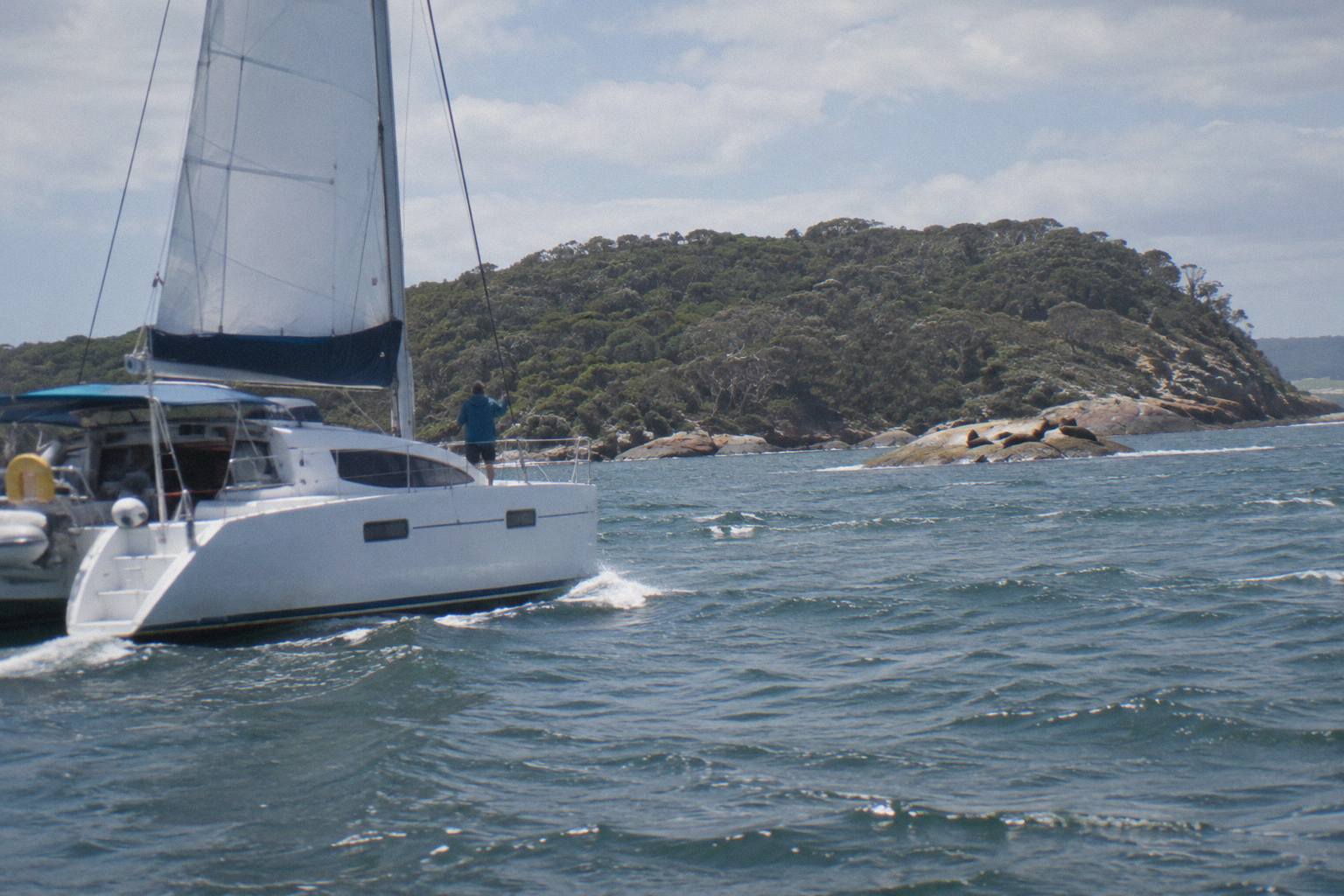
The confusion usually starts with the phrase itself. People remember, or have heard second-hand, that you could once slip into the water next to a pod, and they assume a rule change killed it. In NSW the rules that exist are about boats: how close a vessel may come to a dolphin, how it must behave inside a caution zone, and what happens when dolphins ride the bow wave. Those rules say nothing about a person swimming, and nothing about touching.
What is true, plainly, is that the dolphin boat trips available in Nelson Bay do not include a swim with dolphins. None of them. The boom net rides on several cruises are net rides, a net slung off the vessel that guests sit in while the boat moves. The snorkel trip snorkels at an island, with dolphins sometimes seen on the way. If a swim with wild dolphins is the specific thing you want, one operator in Port Stephens runs something close to it, and it sits outside the cruise products entirely.
The rest of the answer is worth understanding anyway, because it changes what you book. Knowing why the boats hold their distance, and what the research found about boats and feeding dolphins, makes the deck-based trips feel less like a compromise and more like the point.
What The NSW Approach Rules Actually Say
Under the NSW Government's approach distances, a vessel may come no closer than 50 m to a dolphin, the dolphin caution zone starts at 150 m, and with a calf present a boat may not enter the caution zone for closer viewing at all. A mostly white animal carries a 500 m distance in every case. Jet skis must stay 300 m away, drones 100 m and helicopters 500 m. These are rules for vessels, published by the NSW Government, and they shape every dolphin cruise in Port Stephens more than any swimming rule does.
Inside the caution zone the behaviour rules are specific. A vessel approaches from the side, at least 30 degrees off the animal's direction of travel, at constant slow speed, with a lookout posted when two or more people are on board. No more than three vessels may be inside the whole caution zone at once. And when dolphins choose to bow-ride, the vessel maintains its course and speed rather than reacting, which is why a cruise sometimes seems to ignore the pod playing at the front of the boat.
| Situation | Minimum distance | What a vessel must do |
|---|---|---|
| Dolphin, open approach | 50 m | Keep outside; caution zone begins at 150 m |
| Dolphin with a calf | 150 m | May not enter the caution zone for closer viewing |
| Mostly white animal | 500 m | Applies in every situation |
| Inside the caution zone | 150 m to 50 m | Approach from the side at least 30 degrees, constant slow speed, lookout posted |
| Bow-riding dolphins | Within the zone | Maintain course and speed |
| Jet ski | 300 m | Stay outside |
| Drone | 100 m | Stay outside |
The full detail sits on the NSW Government's approach distances page, which is the primary source for every figure in the table above. Note what the rules govern and what they do not. They are written for vessels. They say nothing about a person in the water and nothing about touching a dolphin, so any claim that "NSW law bans swimming with dolphins" goes beyond what the rules themselves state. The plain framing is simpler: the law constrains the boats, and the boats have never been swim products.
Operators add their own practice on top of the law. Moonshadow-TQC Cruises describes limiting itself to no more than two boats with a pod for around 30 minutes, which is the operator's own stated practice rather than the legal rule. If dolphins approach a boat, the vessel holds course and speed and lets the encounter happen on the dolphins' terms. That is the legal requirement, and it is also the reason deck-based watching works: the resident pod is habituated to slow vessels, and the skippers know where they feed.
The resident pod itself is protected by the Port Stephens-Great Lakes Marine Park, created in 2005 with four zone types: sanctuary, habitat protection, general use and special purpose. Boating, snorkelling and diving are all allowed in sanctuary zones. The NSW Department of Primary Industries identifies two 4-knot speed areas, at Middle Grounds and across the whole Jimmys Beach sanctuary zone, as important resting and feeding habitat for the resident bottlenose dolphins. Slow zones for feeding dolphins are the marine park's clearest statement of priority: the dolphins' rest comes before the visitors' proximity.
What Dolphin Watching Does To Wild Dolphins
A 2012 Journal of Environmental Management paper, using boat surveys from August 2008 to August 2009, found dolphins fed and socialised less while dolphin-watching boats were present, and groups with newborns came closer than the minimum distances in nine of ten encounters. It is 2008 to 2009 data from before the current approach rules, so it cannot be read as a measure of today's boats, but it is the strongest published evidence for why regulators keep vessels at a distance at all.
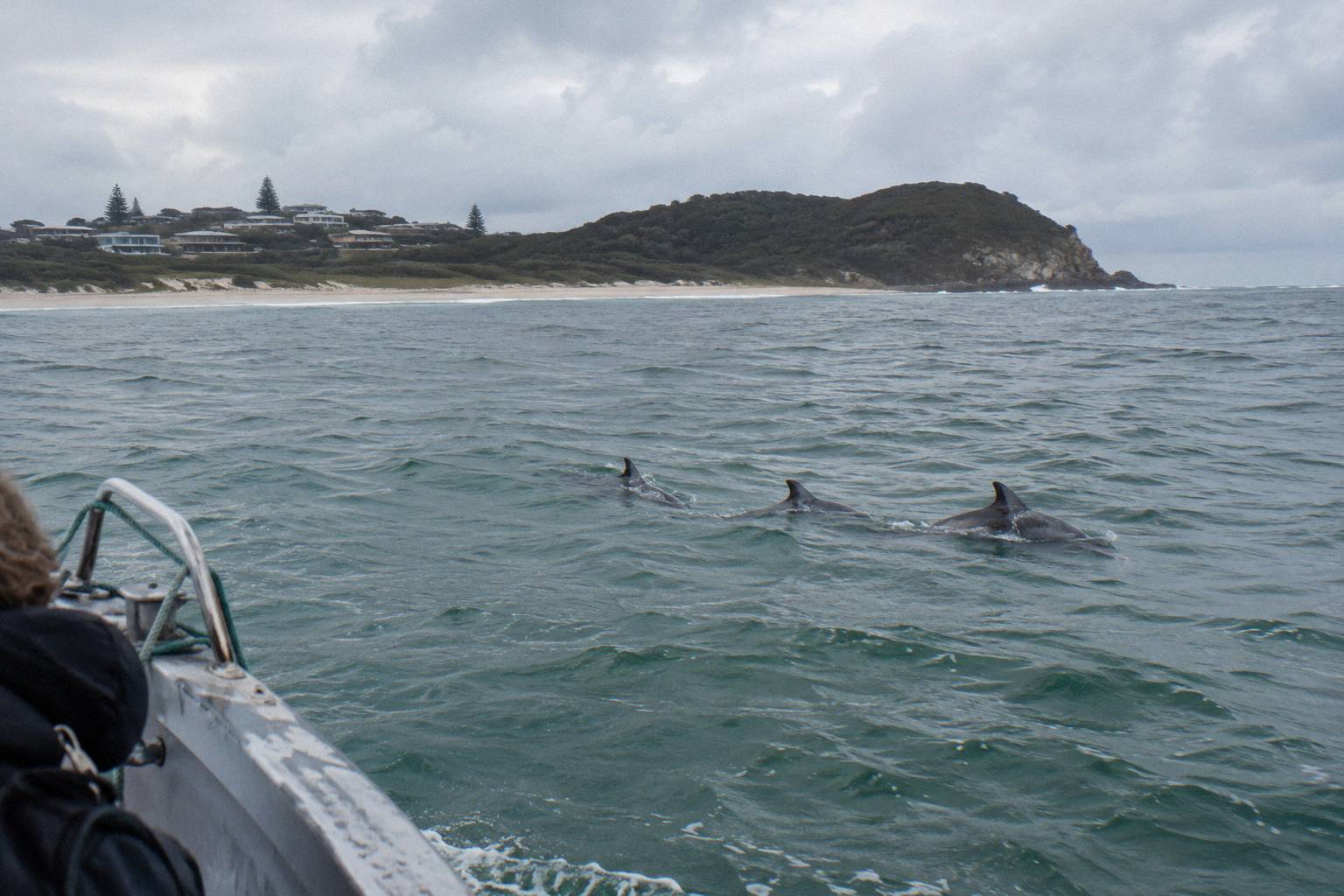
The study, by Steckenreuter, Moller and Harcourt, matters here for one reason: the mechanism it measured is disturbance, not contact. Feeding time is the currency of a dolphin's day, and a pod that interrupts feeding to investigate or avoid boats pays a real energetic cost. A swimmer in the water multiplies that problem, because a swimmer cannot hold a legal distance the way a boat can, cannot approach from a fixed angle, and cannot be regulated by a skipper once they are over the side. The paper is published open in the Journal of Environmental Management for anyone who wants the methodology in full.
This is where the question's premise bends. Even without a swim ban, the welfare case for structured, vessel-based watching is straightforward. The Nelson Bay model, big stable boats, mandated distances, operators who publish their own sighting terms, keeps the pressure on the pod low while still delivering encounters. Moonshadow says plainly that its dolphins are totally wild and that 100 percent sighting success is not guaranteed, offering a non-transferable free return voucher on a standby basis rather than a refund if no dolphins are found. Imagine's sailing cruise carries a Dolphin Guarantee (Free Return). No operator promises the dolphins, which is itself a marker of an operation built around a wild population rather than a performance.
Worth knowing too: the Port Stephens pod is genetically distinct. Macquarie University research cited in the NPWS visitor guide found the population seldom interbreeds with coastal dolphins, and some animals travel outside the Heads, with a second community living near Broughton Island about 20 km away. A resident, semi-isolated population of 90 to 120 animals cannot easily replace individuals lost or stressed out of the bay, which is why the marine park's feeding-area speed limits and the state's approach distances both land hardest in exactly the place most visited by boats. More background on the pod sits in the guide to the resident bottlenose dolphins of Port Stephens.
Does Anyone Still Run A Swim With Wild Dolphins?
One operator does: Dolphin Swim Australia, a specialist business that is separate from every cruise product available here, runs a wild dolphin swim, at the operator's own price of A$359 per person, for ages 7 and over, on a 4.5 hour trip running from 6:15am to 11:00am. Departures are Friday, Saturday and Sunday plus extra school-holiday sailings, from October to the end of April. Swimmers hold a tow rope or harness behind a sailing catamaran, with up to 24 swimmers per trip, and wetsuit, mask, snorkel and brunch included per the operator.
That paragraph is the operator's own description, priced and framed as the operator states it. It is deliberately kept apart from the cruise products, because it is a different category of experience at a different price, and because none of the Nelson Bay dolphin cruises put you in the water with the pod. The operator offers a free return within 12 months if you do not get a swim, and says "no guarantees". More answers sit in the operator's own frequently asked questions.
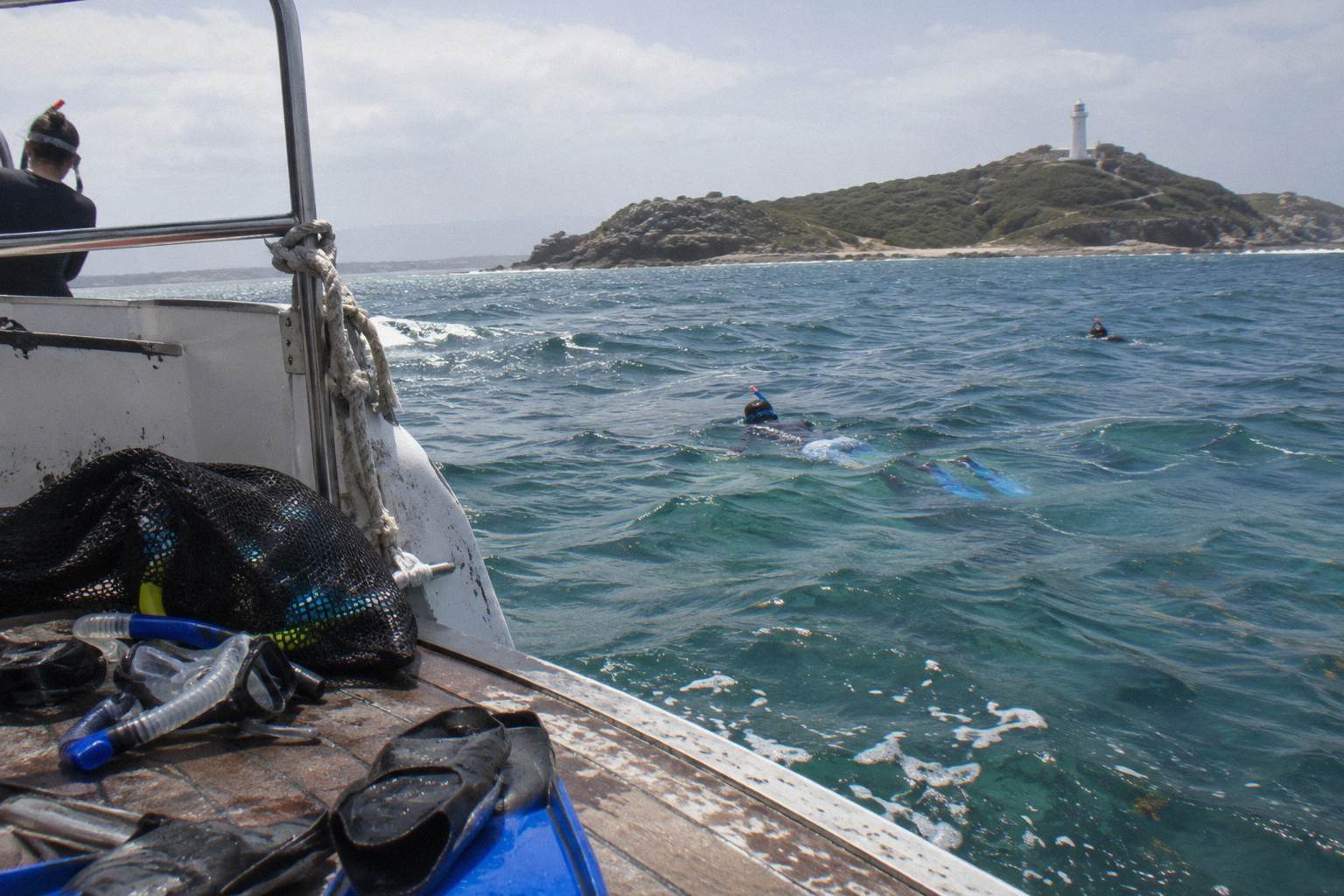
So the accurate picture is a spectrum. At one end, a highly regulated swim product run by a specialist operator under its own permit and terms. In the middle, nothing: no cruise in Nelson Bay mixes watching with swimming alongside the pod. At the other end, the deck-based cruises, the boom net rides and the island snorkel, all of which keep passengers and dolphins in separate elements. The spectrum exists because the permit system treats a structured swim behind a catamaran as a controllable activity, with a tow rope, fixed swimmer numbers and a crew whose whole job is that one product.
If a swim is the goal, the practical guidance is to book the swim product directly with its operator, check its October-to-April season and weekend schedule against your travel dates, and read its age minimum of 7 years before promising children. If any of those constraints rule the swim out, the rest of the port still has genuine water contact on offer, just not with dolphins, and the next section covers what that actually looks like.
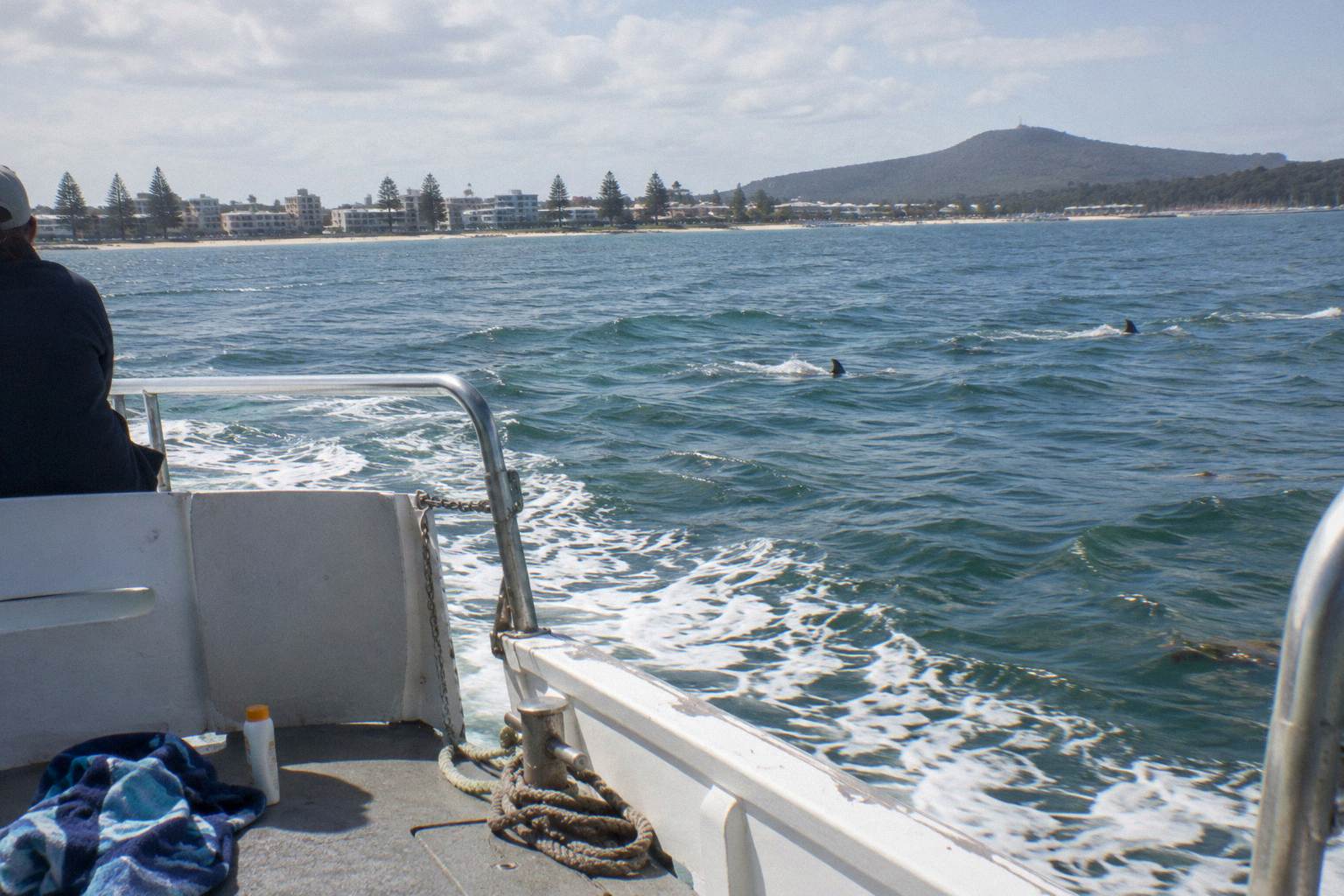
What The Nelson Bay Boats Offer Instead
Every dolphin cruise available here is a deck-based trip, and the water contact on offer is the boom net, a net slung off the vessel that guests sit in while the boat moves, never a swim with dolphins, plus one island snorkel cruise. The boom net appears on the Dolphin Discovery cruise, the BBQ and Boom Net cruise, the Imagine sailing cruise and the Marine Discovery snorkel cruise, and as an option on two day trips. It stays on the boats named here and nowhere else.
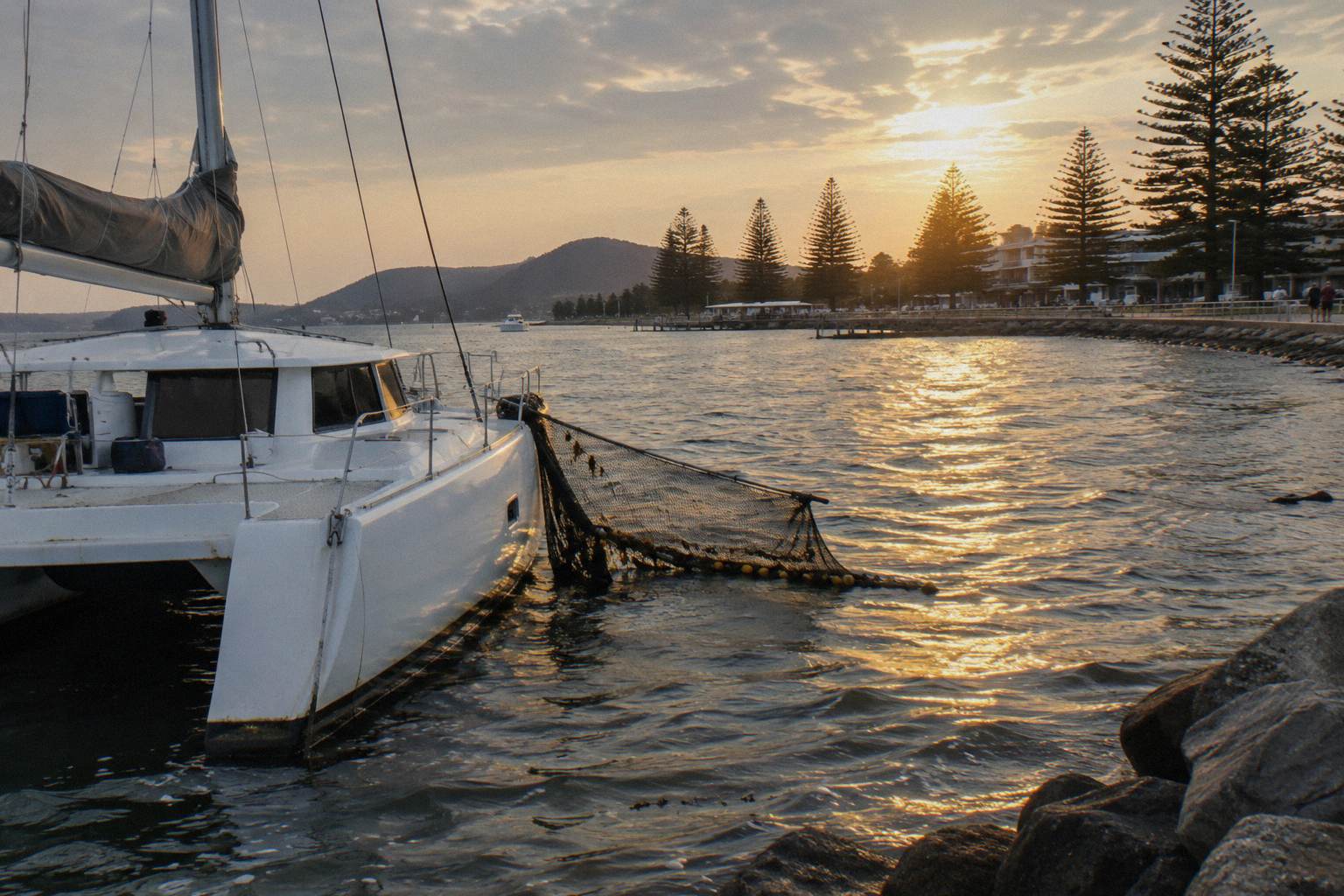
The boom net deserves its own explanation, because it is the closest thing to "getting in the water" that the cruise products include, and misreading it is common. It is a ride, not a swim. You sit in the net, the boat moves, seawater sloshes through, and the dolphins remain wherever the dolphins choose to be, usually somewhere else entirely. No operator here claims a dolphin approaches the net on purpose, and the Dolphin Discovery cruise keeps its boom net inshore. Bring a swimsuit and towels, because neither is provided. The full picture of the net ride is in the guide to the boom net experience in Nelson Bay.
| Trip | Operator | Duration | Water contact | Price shown |
|---|---|---|---|---|
| Dolphin Discovery Cruise | Moonshadow - TQC Cruises | 1.5 hours | Boom net, kept inshore | From A$46 per person |
| Dolphin Watch Cruise and Sail | Imagine Cruises | 1.5 hours | Dry bow-net and wet boom-net | From A$50 per person |
| 1-Hour Dolphin Watch Express | Aquamarine Adventures | 1 hour | None, deck watching only | From A$55 per person |
| Marine Discovery Snorkel Cruise | Imagine Cruises | 3.5 hours | Island snorkel, bow-net and boom-net | From A$100 per person |
| Wild Port Stephens Marine Park Cruise | Moonshadow - TQC Cruises | 1.5 hours | None, no boom net | From A$46 per person |
For actual swimming, the Marine Discovery Snorkel Cruise from Imagine Cruises is the water trip: 3.5 hours with a qualified dive-master guide, snorkel, fins and mask included, sailing when conditions permit, with bow-net and boom-net riding, commentary, and dolphins seen en route per the operator, from A$100 per person. It runs on a sailing catamaran out of d'Albora Marina, tea, coffee and water are included, wetsuits and towels are not, and guests must be able to swim to snorkel, with non-swimmers welcome as observers. Book it through the Marine Discovery snorkel cruise page and check dates and the current price there.
If watching rather than swimming is the aim, the shortest option is the 1-Hour Dolphin Watch Express from Aquamarine Adventures, from A$55 per person, 4.9 from 62 reviews, a fast power-catamaran run out to the resident bottlenose dolphins. For a quieter pace, the Dolphin Watch Cruise and Sail from Imagine runs 1.5 hours on a sailing catamaran from A$50 per person, 4.8 from 106 reviews, with dry bow-net and wet boom-net options and self-service tea and coffee, though it only runs November to April and must never be assumed to sail in winter. Choosing between watching styles is covered in the guide to which boat gets you closest to the dolphins.
For families weighing the whole question, ages matter. Moonshadow's child band runs 4 to 14 with infants 0 to 3, and on its boom net children under 1.1 m may not use the net unattended, with smaller children riding with an adult. Prams are not allowed on Moonshadow vessels, though the crew stores collapsible strollers. The broader age rules, pram policies and minimum ages for every trip are laid out in the guide to dolphin boat trips with kids in Port Stephens.
Boom Net, Snorkel Cruise Or Wild Swim: Which Is Which
The three water experiences are distinct products: the boom net is a net ride on a dolphin boat from A$46, the snorkel cruise is an island snorkel with dolphins possibly en route from A$100, and the wild swim is a separate specialist product at the operator's own price of A$359 that is not among the cruises available here. Choosing between them is mostly a question of whether you want dolphins, water, or both, in that order.
| Experience | What it is | Water contact | Season | Price shown |
|---|---|---|---|---|
| Boom net (Dolphin Discovery) | Net ride off a dolphin-watching vessel, cruise stays inshore | Sit in a net while the boat moves | All year | From A$46 per person |
| Marine Discovery Snorkel Cruise | 3.5 hour sailing and snorkel trip to an island, dive-master guide | Snorkelling at the island, boom net on board | Check dates when booking | From A$100 per person |
| Wild Dolphin Swim (Dolphin Swim Australia) | Tow-rope swim behind a catamaran, separate operator, not bookable here | Swimming while holding a rope or harness | October to end of April, select days | Operator's own price A$359 per person |
The comparison in one sentence: the boom net gets you wet next to a boat, the snorkel cruise gets you swimming next to fish, and only the swim product puts a rope in your hands with dolphins in the water. Prices are in Australian dollars, per person, and every operator calls them "from" prices; child and family fares are set by each operator and shown when you check availability. All prices change, so treat the figures here as the current picture and confirm at the point of booking.
Cancellation terms are more consistent than you might expect. Every cruise trip available here carries free cancellation up to 24 hours before departure for a full refund. Moonshadow's own terms add detail on its vessels: a standard cruise cancelled inside 24 hours is charged in full, amendments attract an admin fee, missing the departure means no refund or transfer, and if the operator cancels you receive a full refund or a transfer. If you are lining up a swim, a cruise and a day trip in one visit, the 24-hour rule gives you room to shuffle plans, but anything inside that window turns into a commitment.
Common Mistakes People Make Chasing A Dolphin Swim
The recurring errors are assuming a cruise includes a swim, assuming the boom net is a dolphin encounter, assuming the sailing cruise runs all year, assuming a dolphin sighting is promised, and turning up at the wrong marina for the trip booked. Each mistake is avoidable with one piece of knowledge, and each one regularly turns up in disappointed reviews of otherwise good trips.
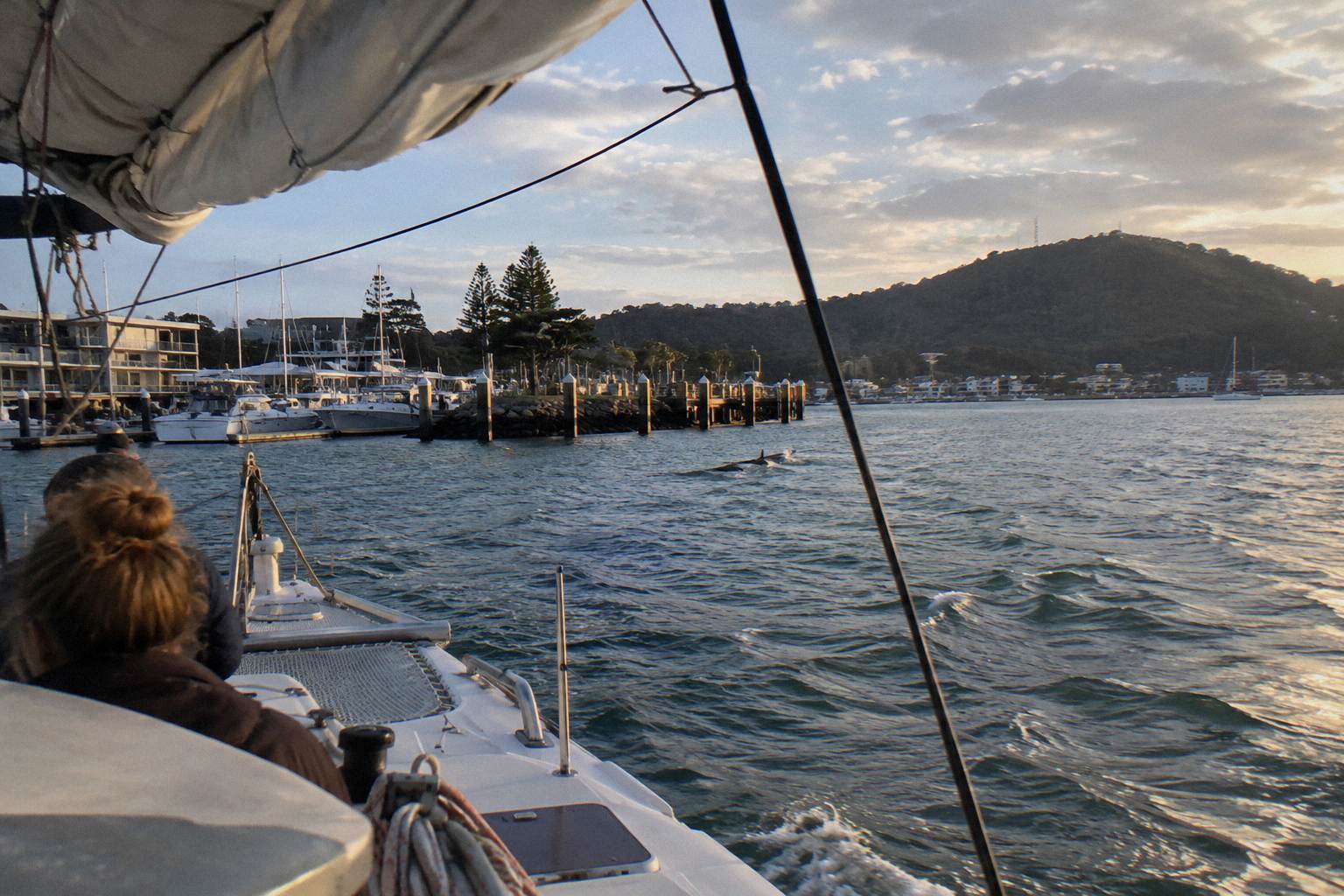
The first mistake is booking a dolphin cruise and packing a swimsuit for the wrong reason. The swimsuit is for the boom net, and the boom net is a ride in a net with no dolphin involvement. Guests who understood the net as "swimming with dolphins" are the ones who feel short-changed, even on a cruise that found the pod perfectly. Read the trip description for the words "boom net" and treat them as a water ride, nothing more.
The second is season blindness. Imagine's Dolphin Watch Cruise and Sail runs November to the end of April, and the BBQ and Boom Net cruise runs December to April, while Moonshadow's dolphin cruises run all year every day except Christmas Day. A winter visitor who fixates on the sailing cruise will find it not running, and a summer visitor who fixates on it without checking the calendar may miss the last sailings. Moonshadow describes late morning and early afternoon departures, with an extra afternoon departure in school holidays outside winter, but clock times live on the booking calendar, not in general knowledge.
| Trip | Season | Operator |
|---|---|---|
| Dolphin Discovery Cruise | All year, every day except Christmas Day | Moonshadow - TQC Cruises |
| Dolphin Watch Cruise and Sail | November to the end of April | Imagine Cruises |
| BBQ and Boom Net Cruise | December to April | Moonshadow - TQC Cruises |
| Wild Dolphin Swim | October to the end of April, Friday to Sunday plus school holidays | Dolphin Swim Australia |
| Whale Watching Express Cruise | May to November season | Aquamarine Adventures |
The third is overreading sighting promises. No cruise guarantees dolphins. Moonshadow says so directly and backs the trip with a standby return voucher rather than a refund; Imagine attaches a Dolphin Guarantee (Free Return) to its sailing cruise. Some guests report dolphins on the whale watching express, an Aquamarine trip from A$99 that is ages 5 and over and carries a whale guarantee with a 12-month return voucher, but that is a seasonal whale boat, not a dolphin product. More on the likelihood question sits in the guide to how likely you are to see dolphins from a Nelson Bay boat.
The fourth mistake is arriving at the wrong place. Most dolphin boats leave from d'Albora Marina on the Teramby Road side of Nelson Bay, and the dock for your trip is the one on your booking confirmation, but the BBQ and Boom Net cruise boards at Wharf 1, the Cruise Passenger Terminal at 40 Victoria Parade, a different place altogether. Moonshadow asks guests to board about 15 minutes before departure. Parking around the marina is paid for up to 4 hours between 8:30am and 4:30pm, though some nearby streets, Laman, Church and Magnus, are free and unlimited, and payment is by card, coin or the Park'nPay app with your number plate as the ticket. Port Stephens Dolphin Cruises keeps the boarding detail for every trip alongside each product so the marina never eats your departure.
Common Questions About Swimming With Dolphins
Why Can't You Swim With Dolphins Anymore?
There is no single swim ban with a start date. What exists is a set of NSW vessel approach rules, a marine park with protected dolphin feeding areas, and a cruise fleet that has never included a swim with the pod. One specialist operator runs a wild dolphin swim, outside the cruise products.
Can You Swim With Dolphins In Port Stephens?
Not on any dolphin cruise. The boats watch from the deck, and the boom net is a net ride rather than a swim with dolphins. A separate operator, Dolphin Swim Australia, runs a wild dolphin swim at its own price of A$359 per person, ages 7 and over, October to the end of April on select days.
Is The Boom Net The Same As Swimming With Dolphins?
No. The boom net is a net slung off the vessel that guests sit in while the boat moves. It is a water ride with no dolphin involvement, and no operator claims a dolphin approaches the net on purpose. Bring your own swimsuit and towels.
How Close Do The Dolphin Boats Get?
NSW rules allow a vessel no closer than 50 m to a dolphin, with a caution zone starting at 150 m, and no closer than 150 m at all when a calf is present. If dolphins bow-ride, the vessel maintains course and speed. Operators add their own practices on top of the legal minimums.
Which Cruise Includes Actual Swimming?
The Marine Discovery Snorkel Cruise from Imagine Cruises, 3.5 hours from A$100 per person, with a dive-master guide, snorkel, fins and mask included. It snorkels at an island, with dolphins seen en route per the operator; it is not a swim with dolphins.
Do Any Tours Guarantee You Will See Dolphins?
No. Moonshadow states that 100 percent sighting success is not guaranteed and offers a non-transferable standby return voucher if dolphins are not located. Imagine's sailing cruise carries a Dolphin Guarantee (Free Return). The dolphins are totally wild, and no trip promises them.